Blog Archives
God Has Friends In Low Places
The other day I was sitting out in the backyard listening to an audio book and getting a much-needed dose of vitamin D. Two Mockingbirds were darting back and forth just feet in front of me and were making so much noise that it was becoming difficult to hear my audio book. I knew that they had a nearby nest and were only trying to protect their young from a potential threat (apparently Mockingbirds don’t understand that paralyzed people in a wheelchair don’t pose a threat).
Then I saw two beautiful Bluebirds sitting in a nearby live oak tree just minding their
own business. Like me, they seemed to be doing their best to ignore the noise and the antics of the paranoid Mockingbirds. Every five minutes or so, one of the Bluebirds would fly over and land on the roof of a dilapidated birdhouse that Mary’s been meaning to replace. After observing this for almost an hour, Mary came outside and told me that the Bluebirds have a nest in that old birdhouse.
 I was thinking that there must be a serious birdhouse shortage in our area for these beautiful Bluebirds to have chosen this run-down dwelling to build a nest. Then I remembered that Jesus was born in a smelly stable. Maybe there was a pair of Bluebirds nesting in that stable too.
I had somewhat of a revelation about the beautiful and holy taking up residence in dwellings that are far beneath them. It’s the one thing that distinguishes genuine Christianity from every other belief-system that can be named; the Holy Spirit (literally) resides in the followers of Christ.
“Or do you not know that your body is a temple of the Holy Spirit who is in you, whom you have from God, and that you are not your own?” (1 Corinthians 6:19)
It’s not a coincidence that Jesus was born in a place that most homeless people would have avoided. But, even if Jesus would have been born in the greatest palace on earth, it would have been far beneath Him. It’s as if God chose the lowest of places to emphasize this.
It’s also not a coincidence that we see this same pattern with the birth of the Church (Acts chapter 2). The Church began with the Holy Spirit indwelling a bunch of very ordinary men and women that were gathered together in a room. From a Holy God’s perspective, that “upper room” was a very “stable-like” scene. But even if the Holy Spirit began His work in the hearts of the holiest of men on earth, it would have been far beneath Him.
The disciples were grief-stricken after Jesus explained to them that He would have to die. He comforted them with the following words:
“I will ask the Father, and He will give you another Helper, that He may be with you forever; that is the Spirit of truth, whom the world cannot receive, because it does not see Him or know Him, but you know Him because He abides with you and will be in you.” (John 1:16-17)
Later Jesus told the disciples that all of them would abandon Him. Peter stated emphatically that he would die with Jesus before denying Him. We now know that, out of fear of being arrested, Peter ended up denying Jesus three times within hours of making that vow.
But after being indwelt with the Holy Spirit (the “helper” and “Spirit of truth”), this same Peter stood before thousands of the very people he once cowered before and boldly declared that Jesus is “both Lord and Messiah.”
This man that was so afraid of being associated with Jesus on the night that He was arrested that he denied even knowing Him, years later would ask to be crucified upside down because he didn’t feel worthy to die in the same manner as his “Lord and Messiah.”
Biblical knowledge is so important, but theological knowledge alone cannot transform a person the way Peter and the other disciples were transformed: only the Holy Spirit can do that. And this kind of radical transformation is the true and lasting message of the Easter story.
“But if the Spirit of Him who raised Jesus from the dead dwells in you, He who raised Christ Jesus from the dead will also give life to your mortal bodies through His Spirit who dwells in you.” (Romans 8:11)
Trials Can Make Us Stronger
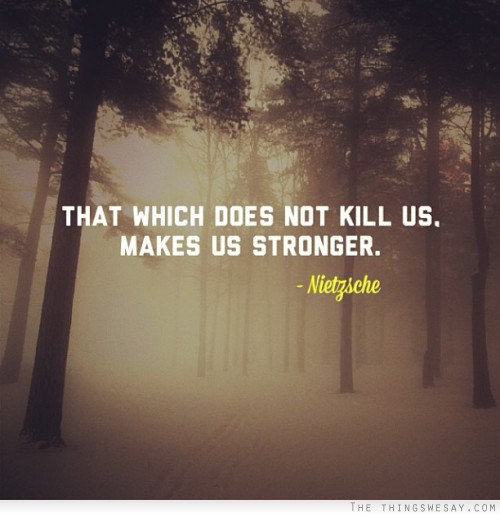
I never thought that I would be using a quote from the atheist philosopher Friedrich Nietzsche in one of my blog posts, but…
This quote came to my mind the other day and I began thinking about it and the man that wrote it. I spent most of February sick or recovering from the flu and other health issues. What little strength and energy I had before the illness has finally returned in the last few days. I’m definitely not physically stronger than I was before the illness. But I do feel spiritually stronger than I was before my battle with “that which did not kill me.”
As an atheist, Nietzsche only believed in the physical world so I can only assume that this quote was referring to trials making people (himself) physically and/or emotionally stronger. I wonder if he still believed those words while lying helpless and suffering from the effects of Syphilis for the last eleven years of his life.
As someone who has relied on caregivers for even longer than Nietzsche had to (ALS, not Syphilis), I empathize with the helpless, the suffering and their caregivers. But I feel great sympathy for those that do not place their hope and strength in Christ, regardless of the state of their health. I feel sympathy because, like Nietzsche, the “strength” and “hope” that they derive from physical/temporal pleasures do not provide genuine and lasting joy or peace. As King Solomon concluded, it’s “all vanity.”
I am convinced that the following is the only strength that can be gained from “that which does not kill us”:
“…we do not lose heart, but though our outer man is decaying, yet our inner man is being renewed (strengthened) day by day. For momentary, light affliction is producing for us an eternal weight of glory far beyond all comparison, while we look not at the things which are seen, but at the things which are not seen; for the things which are seen are temporal, but the things which are not seen are eternal.” (2 Corinthians 4:16-18)
There are so many great earthly pleasures and blessings, but not even the best of them deserve our hope. If Christ is our hope, the pleasures we enjoy on earth will be so much more enjoyable because we’ll have our priorities in order and we won’t have to rely on the physical/temporal things for happiness.

“For in hope we have been saved, but hope that is seen is not hope; for who hopes for what he already sees? But if we hope for what we do not see, with perseverance we wait eagerly for it.” (Romans 8:24-25)
Opportunities In Trials
In the midst of a trial, the greatest temptation we face is to hunker down and wait for the storm to pass. I don’t believe this is ever God’s will.
We tend to view trials as a kind of imprisonment, thinking our life is on hold until the day we’re released from the grip of the life challenge. ALS has made me a virtual prisoner of my own body for the last 18 years. It has been a very cruel warden. But I look around me and see other people fighting illness or trying to overcome addictions, depression, abuse, debt and so many other cruel masters.
We must continue to hope and pray for freedom from whatever is trying to “hold us,” and we should do everything in our power to move toward that goal. But, in the meantime, we should look for opportunities for God to use us right where we are. This is what the Apostle Paul did, and I’m convinced it’s what God wants us to do.
It was from prison that Paul wrote the following: “Now I want you to know, brethren, that my circumstances have turned out for the greater progress of the gospel…” (Philippians 1:12)
We don’t usually associate the word “progress” with imprisonment or any kind of trial, but I believe that we should. If we wait until we “have it all together” before we try to help and give hope to others, many will go without help and die without hope.
Would I be a hypocrite telling people that God still heals when I’ve been held in the grip of a terminal disease for 18 years?
Let me answer that with another question: Was Paul a hypocrite for writing about freedom in Christ from the depths of what was likely a rat infested dungeon?
Paul was almost stoned to death by an angry mob and severely beaten other times. He also suffered from what he called “a thorn in his flesh” (many Bible scholars say this “thorn” was poor eye sight). Regardless, it’s unlikely that Paul was the handsome and strong man depicted in the Bible movies. After spending much of his time in prison and enduring countless beatings, he was likely pale and scarred, and probably in pain 24/7. Yet, God used this suffering servant to heal and give hope to others.
The Apostles faced the same trials, temptations and human frailties that we face. Yet, in the midst of trying to overcome their own trials and temptations and battling their own demons, they were feeding the poor, healing the sick and giving hope to others by spreading the good news.
People don’t care about how much we know until they know how much we care. Maybe we wouldn’t have truly learned to care apart from our suffering.
I hope you’re successful in keeping all of your New Year’s Resolutions, and 2015 is the best year you’ve had so far. But we cannot wait for all of our hopes to be fulfilled before we offer help and hope to others.

We overcome as we help others to overcome.
Evil: The Ultimate Opportunist
I recently read a blog post that reminded me of an incident that occurred a few years after Mary and I were married.
I was working for a company that required me to be on-call for one week per month. This was a few years before cell phones were readily available so we still used pagers. I still remember the sick feeling I’d get when I would hear that annoying beeping noise in the middle of the night or during holiday celebrations. I had to drop everything and immediately drive the 30+ miles to work.
Around two o’clock one morning, that annoying beeping noise woke us from a dead sleep. After walking over to the sink and splashing cold water on my face, I called the answering service and heard the message that I was needed at work right away.
While getting dressed, I opened my wallet and discovered that I didn’t have any cash. I quickly looked in Mary’s purse and found that she didn’t have much cash either. I told her that I was going to run by the ATM and get some money on my way to work.
Our bank was located on the service road of the freeway, right on my way to work. It was very convenient, but, even though the location was just off the freeway, it was fairly secluded. At that time, it was the only business in that area; a small building surrounded by dense woods. For this reason, and because the bank didn’t have a drive-through ATM machine, Mary didn’t like me going there at night. That night she again asked me to use the ATM in the convenient store near the front of our neighborhood.
I value Mary’s advice, but the convenient store charged a fee for using their ATM and our bank did not. It’s not that I’m cheap, I just hated paying unnecessary fees so I decided not to take her advice that night.
I had been to our bank’s ATM at night before but never at such a late hour. Other than a few dimly lit lights shining up from the landscaping in front of the building and a small light over the ATM machine, the area was dark and the woods surrounding the building were pitch black.
I parked my car in front of the small building and quickly walked up the sidewalk to the ATM machine. I got an eerie feeling like someone other than the ATM camera was watching me as I punched in the numbers on the keypad. I convinced myself that this was my imagination, but I was still so relieved when the cash popped out so I could finally return to my car and get out of there.
When I was about halfway back to my car, I heard footsteps on the sidewalk behind me. “Could you give me a ride?” the shaky voice of a woman asked. Thinking it was a set up and her boyfriend was going to pop out of the bushes and shoot me, I didn’t even turn around until I reached my car and opened the door.
She was young, twenty years-old at most. I looked over the top of the car as she nervously explained that her car broke down on the freeway. I only heard bits and pieces of what she was saying because I was planning a quick getaway and scanning the hedges in front of the building for any sign of her accomplice. Before even getting my answer, she began sheepishly walking towards my car as if I had agreed to her request.
Still suspicious, I mumbled something about being in a hurry to get to work and moved closer to the open door of my car. “PLEASE DON’T LEAVE ME HERE, I’VE BEEN RAPED,” she shouted as she rushed to my car and frantically tried to open the locked passenger door. I unlocked the door.
She asked me to take her home so her mom could accompany her to the hospital.
After driving a mile or so on the service road, she pointed to her car parked on the shoulder of the freeway and began telling me the horrifying story.
She was at a friend’s house watching a movie. She stayed later than she intended and later than her mom wanted her to. While driving home on the nearly deserted freeway, her car stalled so she parked it on the shoulder and turned the emergency flashers on. She waited in the car for about thirty minutes hoping that a police officer or a Good Samaritan would stop and help her. She finally gave up on that idea and decided to walk the three miles or so to a gas station to call her mom.
Thinking it wouldn’t be safe walking along the shoulder of the freeway, she decided to walk in the grass on the inside of the service road. She had only been walking for about five minutes when, seemingly from nowhere, a large man grabbed her from behind and carried her into the woods where he raped her. Following the brutal assault, the rapist fled one way and the traumatized girl fled the other way. Thinking that he might return to look for her, she hid behind the bushes in front of the bank to figure out what her next move would be. This is when I entered her nightmare, and she decided that I would be her next move.
Evil is the ultimate opportunist.
“Be of sober spirit, be on the alert. Your adversary, the devil, prowls around like a roaring lion, seeking someone to devour.” (1 Peter 5:8)
Evil operates like a lion wandering through the wilderness looking for the young, the weak or otherwise vulnerable prey. An evil lion found a physically vulnerable young girl that night.
But evil doesn’t just search for the physically vulnerable, it also preys on the emotionally and spiritually vulnerable; those isolated by addiction, depression, abuse or one of life’s many other challenges that are so difficult to overcome without the help of others.
I can no longer help those in physical distress, but I can still do my best to help those in emotional or spiritual distress by giving them hope. As Christians, we all have the responsibility to help the hurting, even when, maybe especially when, we’re hurting.
If someone came to your mind when you read that, it’s probably the person that God wants you to help.
What are you waiting for?
“Behold, I send you out as sheep in the midst of wolves; so be shrewd as serpents and innocent as doves.” (Matthew 10:16)
Good Intentions
With all the bad going on in the world, I was thinking about how much better it would be if we acted on most of our good intentions. Not only would the recipients of the good actions be better off, but I’m convinced that the doers of those that act on their good intentions would experience a greater sense of joy, hope and overall contentment.
“The road to hell is paved with good intentions.”
Jesus did say that the southbound road is really wide and the northbound road is extremely narrow (Matthew 7:13), but I don’t remember Him ever mentioning what the pavement was made of. I think legalistic religion would tell us that the road to hell is paved with evil actions (sin). The opposite extreme would tell us that this dark road is paved with legalistic bricks that have impossible-to-keep rules imprinted on them. Like most things, I believe that the truth is somewhere in between the extremes.
When I read the Bible, especially the New Testament, it becomes clear that God views our wrong actions (sins of commission) just as harshly as He does our failure to act on our good intentions (sins of omission). For example, in the Matthew’s gospel (25:31-46), Jesus paints a scary picture of what judgment day will be like:
“…for I was hungry, and you gave Me nothing to eat; I was thirsty, and you gave Me nothing to drink; I was a stranger, and you did not invite Me in; naked, and you did not clothe Me; sick, and in prison, and you did not visit Me.’ “Then they themselves also will answer, “Lord, when did we see You hungry, or thirsty, or a stranger, or naked, or sick, or in prison, and did not take care of You?’ “Then He will answer them, “Truly I say to you, to the extent that you did not do it to one of the least of these, you did not do it to Me.’
The frightening thing about the above passage is that these people who Jesus sent down the dark road, considered themselves to be Christians. If you read between the lines it becomes obvious that these people had developed a habit of not following the promptings of the Holy Spirit or their God-given conscience–they simply quit acting on their good intentions.

“For by grace you have been saved through faith; and that not of yourselves, it is the gift of God; not as a result of (good) works…” (Ephesians 2:8-9),
The Bible is clear that we are not saved by good deeds; we’re saved by grace through a commitment to follow Christ. But that commitment (if genuine) should bear fruit in the form of good works (James 2:18). It’s so easy for Christians to come to a place where we believe that we’re good because we’re not behaving badly. By definition this is self-righteousness. But we don’t overcome evil (in ourselves and in the world) just by not trying to do wrong; we overcome evil by doing good:
“Don’t let evil get the best of you, but conquer evil by doing good.” (Romans 12:21 NLT)
When going through a serious trial, it’s tempting to think that we should somehow be exempt from having to do good works; we might think that we should only be the recipients of the good works of others during these difficult times. Don’t believe this, it will only lead to despair. Our good works might seem insignificant (compared to others) when life’s challenges limit our physical, emotional and/or financial abilities, but, as Christians, we’ll never become exempt from doing good works. This poverty-stricken widow set the perfect example for those going through a trial:
“And He (Jesus) sat down opposite the treasury, and began observing how the people were putting money into the treasury; and many rich people were putting in large sums. A poor widow came and put in two small copper coins, which amount to a cent. Calling His disciples to Him, He said to them, “Truly I say to you, this poor widow put in more than all the contributors to the treasury; for they all put in out of their surplus, but she, out of her poverty, put in all she owned, all she had to live on.” (Mark 12:41-44)
Mary and I are so thankful for the family, friends and even people we didn’t know personally, that have helped us in so many ways throughout this almost 18 year battle with ALS (you know who you are). We don’t even want to think about how much worse this trial would have been had you not acted on your good intentions.
There are so many people in need, but maybe you feel, like I’ve felt at times, that you only have a penny’s worth of help, prayers, words of encouragement or even money to give. Think about the poor widow and just do what you can. I know that God will bless the person you help, and He’ll bless you for acting on your good intentions.
 Unshakable Hope