Blog Archives
When God Intervenes
Before having ALS, I would have thought that it would be the big effects of this disease that cause the most frustration—things like not being able to walk and talk. But it’s losing your ability to do simple things, things you once did with little or no effort, that cause the most frustration. Imagine having an itch you can’t scratch or having a mosquito biting the back of your hand and all you can do is sit and watch as it becomes fat with your blood, leaving another itch you can’t scratch.
Being confined to a wheelchair and not being able to speak would be more bearable if I was able to read books, but even that once-simple pleasure is now impossible. I was especially frustrated with my inability to hold a book and turn its pages when I received a copy of a book titled “When God Intervenes” in the mail two weeks ago. This book was written by a friend named Dabney Hedegard, and I had been looking forward to reading it since she told me about it several months ago. Fortunately, Mary had also been looking forward to reading it so she volunteered to read it to me.
The reason I used the example of not being able to scratch an itch is because the book begins with Dabney visiting doctor after doctor and having test after test to determine what was causing the constant itching all over her body. (I began to itch just thinking about it). Every doctor said or inferred that Dabney was a Hypochondriac. She would soon prove all of those doctors wrong, the hard way!

Dabney endured the constant itching and the sleeplessness that came along with it for five tortuous months. Then, as Dabney retells it in the book, something happened that, by comparison, made her constant itching and the exhaustion seem like a minor annoyance: “I propped my feet on the couch and scratched across my belly, trying to chase away the tickles. In the silence of my apartment, I tried to nap. But my midmorning indigestion had progressed into a heavy weight against my lungs. The roll of fruit-flavored TUMS refused to calm the pressure. Then it happened. One gasp followed by strained constriction— as if someone had popped my lung. I banged my fist to my chest to pound out some relief. Nothing. Sitting up straighter, straighter, I struggled to suck in air. “I c-can’t breathe…”
Dabney’s husband, Jason, rushed her to the ER where doctors discovered a football-sized tumor in her chest; it was Hodgkin’s Lymphoma. In some cases, for some unknown reason, this type of cancer can cause the itching that she was experiencing. To complicate matters and add to the drama of this miraculous story, Dabney was six weeks pregnant with their first child.
This was the start of what would become a ten year trial; a decade of Jason and Dabney having their faith repeatedly tested and God intervening time after time with miracle after miracle. A ten year trial that included four near-death experiences and twice doctors telling Jason, “She’ll never make it through the night.”
“…we also exult in our tribulations, knowing that tribulation brings about perseverance; and perseverance, proven character; and proven character, hope; and hope does not disappoint…” (Romans 5:3-5)
The above passage came to my mind when I read what Dabney said this book was about: “This story is about an ordinary girl in search of hope.” Mary and I saw that passage unfold in Dabney and Jason while reading “When God Intervenes.” This “ordinary girl” finds the hope that she was in search of and is now giving that hope to others through her public speaking engagements, her blog and now through this inspiring new book.
And no, I’m not recommending When God Intervenes just because Dabney flattered me by including a quote from one of my blog posts in the book. I’m recommending this book because reading it encouraged us and increased our faith and hope and I know it will do so for you also.
To order When God Intervenes, click here.
Why Me?
Over the years I’ve had ALS, I’ve become convinced that for a Christian to retain hope in the midst of a difficult trial, he or she must believe that God allowed the trial for a purpose; a purpose greater than what God would have been able to accomplish in and through that person apart from the trial.
“…even though now for a little while, if necessary, you have been distressed by various trials, so that the proof of your faith…may be found to result in praise and glory and honor at the revelation of Jesus Christ…” (1 Peter 1:6-7)
I think every Christian that goes through a difficult trial will eventually ask “Why me?”
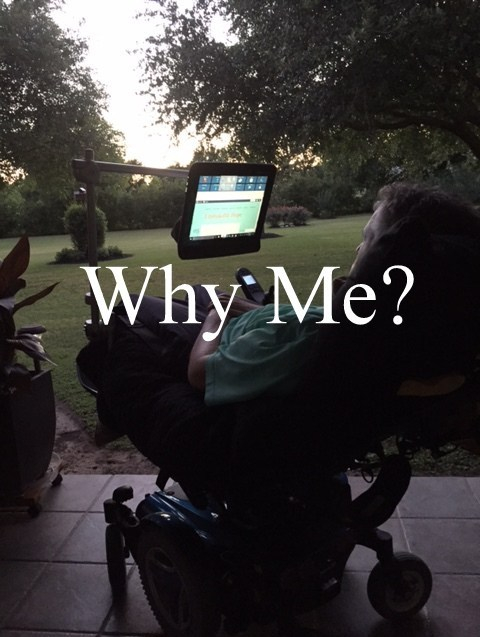
But, I’ve learned that our motive behind asking this seemingly simple question says a lot about how we view God – and also a lot about how we view ourselves.
The first man asks the question like this: “Why me; out of 7 billion people in the world, why did I get ALS (or whatever)?”
He’s really asking, “Why didn’t God put this horrible trial on one of the other 7 billion people?”
This man has a warped view of God and an exalted view of himself. He views his trial as pointless, and he thinks that he should somehow be exempt from the suffering of humanity.
I know what I said about this first man sounds harsh and judgmental, but I know this man well; in a spiritual and emotional sense, I wrestled with him for several months after being diagnosed with ALS.
Thankfully, with the help of God’s word, wise counsel from Christian friends and a well-timed conversation with our non-Christian next-door neighbors, I began to see that there might be a purpose, an eternal purpose, behind my trial. I defeated that “woe is me” man who was fighting to take control of my thoughts and emotions. (More about our next-door neighbors further down).
The second man asks the question like this: “Why me; what’s God’s purpose behind allowing this horrible trial?”
This man has the correct view of God and of his place in the world. As a Christian, this man knows that God wouldn’t have allowed this trial unless He had a greater purpose, a purpose that outweighs the suffering this man would have to endure (from his trial).
“And we know that God causes all things to work together for good to those who love God, to those who are called according to His purpose.” (Romans 8:28)
That verse can only be true if we have an eternal (“Big Picture”) view of our trial. God still heals and performs miracles, and I believe that we should always pray for that result. (Never give up on God doing miracles!)
Regardless of the outcome, God can bring about eternal good from every trial.
In a hundred years, the eternal good that comes from our trial will be the only thing that matters.
A difficult trial (usually) causes the Christian to focus more on the spiritual and the eternal things because, by comparison, the temporal and the material things begin to look more and more insignificant.
Back to our next-door neighbors: Mike and Lorraine were not followers of Christ when we met them. Of course, we did our Christian duty and invited them to church and tried to share the “Good news” with them. Even our girls (then 4 and 7) invited them to church, but all to no avail.
Mike and Lorraine later told us that they mocked us in private. I told them that I could relate because, before making a commitment to follow Christ, I mocked Christians too. Let’s be honest, making fun of Christians is so easy.
But, after I was diagnosed, Mike and Lorraine began to reexamine the faith that was sustaining our family through this trial. Lorraine told me:
“…When you were diagnosed with ALS I began to see a man who held no anger with the God that ‘allowed’ this to happen. Then you began to demonstrate trust in God’s plan. I saw your faith and I saw two little girls accept what God was doing in your lives and I began to wonder how such young children could love God unconditionally. I opened my heart first to the possibility that this might be a good thing for me as well. Then I finally got it and allowed my brain to accept the basic truth that God is only good, loving and faithful…”
Mike and Lorraine made a commitment to follow Christ and faithfully attend church and share their faith with others. (Now people probably make fun of them).
Would Mike and Lorraine have made a commitment to follow Christ if we had not gone through this trial? Obviously, only God knows the answer to questions like this. The only thing I know for sure is that this trial has strengthened my faith and has also given me more confidence in sharing that faith.
But, I admit that difficult trials can feel like you’re serving a prison sentence, especially when you have ALS and you’re imprisoned in your own body. However, the Apostle Paul wrote much of the New Testament while imprisoned. And, many of his fellow prisoners and the guards that observed Paul, became followers of Christ. Only Jesus can spread a message of hope through a prisoner – this is truly Unshakable Hope!
UPDATE: Sadly, Mike went through a long battle with cancer and is now with Christ in heaven. I am looking forward to seeing him again.
I hope I’ll see you there also.
“Now I want you to know, brethren, that my circumstances have turned out for the greater progress of the gospel, so that my imprisonment in the cause of Christ has become well known throughout the whole praetorian guard and to everyone else, and that most of the brethren, trusting in the Lord because of my imprisonment, have far more courage to speak the word of God without fear.” (Philippians 1:12-14)
(I have made changes to my blog, please let me know if you are having problems with it loading…)
Why are so many Christians Depressed?
Depression, even among Christians, seems to be rampant today; it’s as if some kind of emotional black plague has crept into the Church.
I read several blog posts and articles every day, but last week was strange; virtually every day I found myself reading posts and articles written by or about Christians battling depression. But by far the most heart-wrenching news of last week (regarding the impact of depression on Christians) wasn’t found on a blog or in a news article; it was a phone call from a close friend telling us about a friend that had committed suicide.
The young man that committed suicide was named Jordan and he was a very talented artist and musician and, more importantly, he was a Christian. (You can see one of his music videos here and his testimony video here). From what he says in the testimony video, Jordan had battled depression for most of his life, but he seemed to be winning his battle. I don’t know what occurred in his life that caused the depression to come roaring back; maybe only God and Jordan know the answer to that question. But, as someone that believes he is called to offer hope to the hurting, I feel that I must learn more about the enemies of hope. Whatever else depression is, it definitely qualifies as one of the greatest enemies of hope!
As I suppose it is with most people that are diagnosed with a terminal disease or going through other difficult trials, I’ve experienced some difficult days of depression. I don’t remember the order or the full impact, but I imagine to some extent I went through all of the so-called “Five stages of grief” (denial, anger, bargaining, depression and acceptance). But I find myself wondering what it must be like when the most difficult of those stages, depression, IS the trial, as it was with Jordan and it is with so many others.
Despite having every aspect of my life turned up-side-down by ALS, I know little about the kind of deep and dark depression that Jordan suffered from. But, I know from reading the Bible and from my own experience as a follower of Christ, that Christianity offers genuine lasting peace, hope and joy. I wouldn’t be wasting my time typing these posts if I wasn’t convinced of this. Peace, joy and hope are definitely great benefits of the Christian life, but that’s not the “Good News” message that Christ commanded us to preach – Jesus didn’t suffer and die just to make us happy – “Christ Jesus came into the world to save sinners…” (1 Timothy 1:15) Salvation is the good news.

I think this is an important fact because many “seeker friendly” churches preach a message of happiness and prosperity and, if Christians don’t feel happy and/or prosperous, they can feel un-Christian. I cannot help but wonder if the “feel good” gospel message might be exacerbating the feelings of depression among Christians.
The New Testament is an education in how to be Christ-like. But unfortunately this “Narrow path” includes trials and tribulation. My trial is ALS and for others it’s depression. As I said, I know little about that kind of oppressive depression, but I’ve concluded that it’s every bit as crippling to the soul as ALS is to the body.
I don’t feel qualified to offer spiritual advice to those suffering with this kind of depression, but I do have some general hope-building advice for Christians.
The early Christians “…were continually devoting themselves to the apostles’ teaching (reading the Bible…) and to fellowship (getting together with like-minded Christians), to the breaking of bread (church/taking communion) and to prayer.” (Acts 2:42)
One of my blogger friends has suffered from depression for many years. She told me that when she’s feeling depressed, she doesn’t feel like reading her Bible, going to church, getting together with people or praying. This is exactly why doing these things is so necessary. We must do the things our soul (mind, will and emotions) doesn’t “feel like doing” to build hope in our spirit – so our spirit can “preach” to our soul. The spiritual part of us preaching to the mind, will and emotions, isn’t some kind of spiritual schizophrenia; I see examples like the following throughout the Bible; “Why are you in despair, O my soul? And why have you become disturbed within me? Hope in God, for I shall yet praise Him.” (Psalm 42:11)
God also comforts us through other believers; I see examples of this throughout the Bible also. As you can see from reading verses like the following, even the Apostle Paul and the disciples dealt with depression; “…we were afflicted on every side: conflicts without, fears within. But God, who comforts the depressed, comforted us by the coming of Titus…” (2 Corinthians 7:5-6)
Like most of you, I didn’t know Jordan, but, as you can imagine, his family is really grieving his loss so please pray for them – “…pray for one another so that you may be healed. The effective prayer of a righteous man can accomplish much.” (James 5:16)
God Doesn’t Make Sense!
The fact that God’s nature was difficult for me to understand used to be a real challenge to my faith. This was especially true after being diagnosed with ALS. I don’t remember ever asking God “Why me?” but I naturally wondered why God would allow this or any other horrible disease to strike anyone. I began to rethink everything I knew, or thought I knew, about this being we call God.
One of the first things I studied was the Christian definition of God; the Christian belief that God is made up of three separate beings (Father, Son and Spirit) that are actually one being. This doesn’t make sense! I have heard many different analogies that attempted to explain this concept of this three-in-one God by everyone from children’s church pastors to highly-educated Theologians, but I still don’t get it! I know better than anyone that I’m far from being the sharpest knife in the drawer, but after many years of trying to figure out this concept of what we simply call the Trinity, I’ve concluded that no one is able to explain this Triune God in terms that are understandable to even the razor-sharp knives among us. And, I’m now okay with this because –
If we were able to understand God in human terms, He wouldn’t be God; He’d be a man.
C.S. Lewis was one of the best Christian apologists of the twentieth century, but before becoming a follower of Christ, he was an outspoken atheist. He concluded that there was no God because the idea of God didn’t make sense to him. He wondered why a supposedly loving God would allow his mother to die when he was just ten years old. He also wondered why a God that claims to care so much for His creation would permit the horrors he witnessed as a soldier in World War One. I imagine a lot of people asked similar questions after seeing innocent people being killed and maimed in Boston and in West, Texas. But, ironically, it was also this seemingly nonsensical nature of God that brought Lewis back to the God of Christianity.
“Iron sharpens iron, So one man sharpens another.” (Proverbs 27:17)
As a professor at Oxford, Lewis and some other professors, including his fellow professor and friend, the author J.R.R. Tokien (Lord of the Rings) formed a group where they would meet and discuss Philosophy, Theology and other “Big issues.” Tolkien was a Christian and he began challenging Lewis’ conclusions about God. Like me and so many others that have come to a crossroad, Lewis began to rethink his beliefs about this mysterious God.

“Atheism turns out to be too simple” – CS Lewis
Lewis also came to the conclusion that mere mortals were unable to fully comprehend what we call the Trinity. And, like me and those who understand the implications of this conclusion, this idea of an incomprehensible God intrigued Lewis. He eventually ditched his “simple” atheism and turned to a complex God.
He wrote: “On the human level one person is one being, and any two persons are two separate beings… On the Divine level you still find personalities; but up there you find them combined in new ways which we, who do not live on that level, cannot imagine…If Christianity was something we were making up, of course we could make it easier. But it is not. We cannot compete, in simplicity, with people who are inventing religions. How could we? We are dealing with Fact. Of course anyone can be simple if he has no facts to bother about…Reality, in fact, is always something you couldn’t have guessed. That’s one of the reasons I believe Christianity. It’s a religion you couldn’t have guessed.”
Why do we expect to understand why God allows tragedy and heartache when we cannot even comprehend the makeup of God? We haven’t yet even figured out why people do the things they do. God sees the Big Picture – the eternal picture, the picture that we’re incapable of seeing. For that reason alone we should give Him the benefit of the doubt when tragedy strikes.
“For My thoughts are not your thoughts, Nor are your ways My ways,” declares the LORD. “For as the heavens are higher than the earth, So are My ways higher than your ways And My thoughts than your thoughts.” (Isaiah 55:8-9)
Having the Right Perspective
I’ve discovered how essential it is to keep things in perspective in order to maintain hope when you’re in the midst of a trial. The first and most important lesson I learned was focusing on what I have and not on what I’ve lost.

Our family before I was diagnosed with ALS. (Mary still had BIG hair).
Perspective: the capacity to view things in their true relations or relative importance. (Webster’s Dictionary)
I know of many people close to my age, even some close friends, who have died of ALS, Cancer and other diseases or were killed in tragic accidents. These moms and dads have missed being able see their children growing up. They weren’t there to take pictures before prom, to watch with pride as their child graduated from high school and/or college or to witness their son or daughter’s wedding.
I force myself to think about these friends and acquaintances when I begin feeling depressed about my inability to fully participate in this thing we call life. At times like last year when my daughter got married, and I was unable to walk her down the aisle or dance with her at the reception. During difficult times like this, I make a conscious effort to think about some of these people that are no longer with us; people like my friend Rick, who died of Cancer, leaving a wife and two teenage sons. I think about another blogger named Patrick, who died of ALS in December leaving a wife and a teenage son and daughter. Sadly, Rick and Patrick won’t get the opportunity to watch with pride as their children go through graduations, weddings and other landmark events in their lives.
I think about these people every time I’m tempted to complain or get depressed about my situation. I ask myself what they’d say to me if I was to complain about things like not being able to walk my daughter down the aisle at her wedding. Would they tell me that I should be grateful for just getting to be there to watch as she walked down the aisle? Of course, Rick, Patrick and the others have gone on to heaven so I don’t know what they might say to me. But I know they would be right if they were able to tell me to be grateful that I was able to be there for all the events that they’ve missed and will miss. In a sense, I feel that I owe them; that, if for no other reason, I must be grateful for their sake.

Our son-in-law and daughters (January, 2012).
I know it’s strange for me to imagine what deceased people might say to me (to give me the proper perspective), but it works for me and, regardless of the trial that you find yourself in, we all must find ways of coping; ways of changing our perspective and attitude – ways of convincing ourselves that our life isn’t so bad after all.
“…I have learned to be content in whatever circumstances I am.” (Philippians 4:11)
The aim of every Christian should be learning to be content in the good times and in the bad times. But, for those that hope in God, contentment does not mean we stop believing for better days ahead; it just means we’re grateful for today and that we’re going to live it to the full – even if we have to live today in a wheelchair!

“For in hope we have been saved, but hope that is seen is not hope; for who hopes for what he already sees? But if we hope for what we do not see, with perseverance we wait eagerly for it.” (Romans 8:24-25)
 Unshakable Hope