Blog Archives
What Are You Seeking?
I follow a Bible reading plan every year, and the plan I’m following this year begins with John’s Gospel. I’ve always thought it was much more than a coincidence that the first words spoken by Jesus (in John’s Gospel) come in the form of a very profound question; it’s a question that everyone should know the answer to:
“What are you seeking? (John 1:38)
When I read that question on January 1st, I paused to think about what I should be seeking this year. I believe that our New Year’s Resolutions, or lack of, tell a lot about what we’re seeking. The following is a list of the top ten New Year’s Resolutions for 2014. Other than showing that we smoke too much, spend too much, sit too much and eat too much, what does this list tell us about the American people?
- Lose weight.
- Improve finances.
- Exercise more.
- Get a new/better job.
- Eat healthier.
- Manage stress better.
- Quit smoking.
- Improve a relationship.
- Quit procrastinating.
- Set aside time for yourself.
Besides being obsessed with our bodies and being guilt-ridden over repeatedly doing the things we don’t like, it seems to me that we’re focused on treating symptoms instead of the disease. I think all of these resolutions are good, but notice that none of the top 10 resolutions are in any way spiritual. Maybe that’s why only around ten percent of those that make resolutions succeed in keeping them. And of that ten percent that succeeds at conquering a habit or addiction, a large percentage of those will simply replace that habit or addiction with an equally destructive behavior. It seems that we’re trying, and mostly failing, to fight the flesh with the flesh.
Jesus and the Apostles tell us that we should be seeking the things which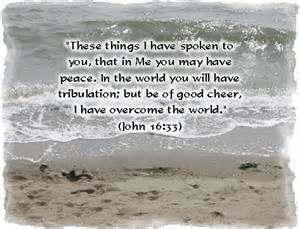 lead to peace. Not “world peace,” but our inner-peace. I’m not a psychiatrist or an addiction counselor, but it seems to me that a lack of inner-peace is at least partially, if not mostly, to blame for the majority of our bad habits, addictions, bad attitudes and other negative behaviors.
“For the mind set on the flesh is death, but the mind set on the Spirit is life and peace…” “So then we pursue the things which make for peace and the building up of one another.” (Romans 8:6 & 14:19)
I haven’t yet perfected this inner-peace thing, but I’ve come a long way over the last ten or fifteen years. I’ve discovered that seeking peace through doing things like reading the Bible, prayer, listening to sermons and having like-minded friends, including blog friends, will greatly increase our sense of peace. If our primary focus is on seeking peace—the Prince of peace, we make Christ our partner in overcoming addictions and bad habits and bad attitudes.
“Be anxious for nothing, but in everything by prayer and supplication with thanksgiving let your requests be made known to God. And the peace of God, which surpasses all comprehension, will guard your hearts and your minds in Christ Jesus.” (Philippians 4:6-7)
Even if you’ve already broken your resolutions, reset your priorities and start over again. Make seeking peace your number one goal and it will increase your joy and hope and give you the strength to conquer your “demons.”
“Now may the God of hope fill you with all joy and peace in believing, so that you will abound in hope by the power of the Holy Spirit.” (Romans 15:13)
Learning To Empathize
As I begin typing this post, Ann, one of Mary’s oldest and closest friends, is having surgery to remove cancer from her body. Later she’ll have to go through radiation and chemotherapy treatments. In faith we are praying and believing that, like my friend Dabney in my last post, this friend will fully recover—she “will not die, but live, And tell of the works of the LORD.” (Psalm 118:17)
Ann is a great example of a Christian that demonstrates true empathy. She doesn’t merely feel sympathy for those going through difficult times; she walks through the difficult time with them. One of the many ways that she demonstrates empathy is by cooking and delivering meals to fellow church members, friends and family that are ill or otherwise going through difficult times.
What’s the difference between empathy and sympathy?
To feel for the person going through a trial is sympathy. To feel with a person going through a trial is empathy. Sympathy is merely a feeling that may or may not result in productive action. And, as in the case of giving money to an addict for instance, sympathy can result in actions that are counter-productive.
I think most people are born with a capacity to feel sympathy, but I believe that empathy, in the Christian sense of the word, is something we learn through the humbling effects that come through life’s many challenges and difficult trials.
“I do not ask the wounded person how he feels; I myself become the wounded person.”
Walt Whitman
Before being diagnosed with ALS almost seventeen years ago, I was one of those that thought empathy and sympathy were basically synonymous, just like the thesaurus tells us they are. But, through the humbling of this trial and through people showing us genuine Christ-like empathy, I now know the difference between sympathy and empathy. (It’s been a tough grammar lesson).
“For we do not have a high priest who is unable to empathize with our weaknesses, but we have one who has been tempted in every way, just as we are—yet he did not sin.” (Hebrews 4:15)

As I said, from a Christian viewpoint, I no longer believe that empathy and sympathy are synonymous. But I found another word that I believe should be a synonym for empathy—Grace. When I began thinking about writing a post on empathy, I was trying to think of Biblical examples (of empathy) that I could use. Before even opening my Bible program to start searching, example after example began flooding my mind; so many examples that I had to quickly open a Word document to type them out before I forgot.
I guess I never saw it this way before, but the New Testament is a book about empathy; Jesus came to demonstrate God’s empathy for man and to teach us how to empathize with one another. His mission of empathy can be summed-up by two of the most well-known verses; John 3:16 (“For God so loved the world, that He gave His only begotten Son, that whoever believes in Him shall not perish, but have eternal life.”), which demonstrates God’s love and empathy for man, and the so-called “Golden Rule” (“…treat people the same way you want them to treat you…” Matthew 7:12), which tells us to empathize with one another.
But Jesus knew that the best way to teach, especially to children and to a simpleton like me, is through telling stories; no story teaches empathy better than the Parable of The Good Samaritan:
“A man was going down from Jerusalem to Jericho, and fell among robbers, and they stripped him and beat him, and went away leaving him half dead. And by chance a priest was going down on that road, and when he saw him, he passed by on the other side. Likewise a Levite also, when he came to the place and saw him, passed by on the other side. But a Samaritan, who was on a journey, came upon him; and when he saw him, he felt compassion, and came to him and bandaged up his wounds, pouring oil and wine on them; and he put him on his own beast, and brought him to an inn and took care of him. On the next day he took out two denarii and gave them to the innkeeper and said, “Take care of him; and whatever more you spend, when I return I will repay you.”
Which of these three do you think proved to be a neighbor to the man who fell into the robbers’ hands? And he said, “The one who showed mercy toward him.” Then Jesus said to him, “Go and do the same.” (Luke 10:30-37)
Obviously we don’t know what was in the minds of the two men who saw this “half dead” man and purposely avoided him. I have to assume that even these self-righteous religious leaders felt some sympathy for the poor guy, but only the Samaritan felt and acted on empathy.
Compassion is empathy in action; sympathy is merely a feeling.
“No one cares how much you know, until they know how much you care”
Theodore Roosevelt
When God Intervenes
Before having ALS, I would have thought that it would be the big effects of this disease that cause the most frustration—things like not being able to walk and talk. But it’s losing your ability to do simple things, things you once did with little or no effort, that cause the most frustration. Imagine having an itch you can’t scratch or having a mosquito biting the back of your hand and all you can do is sit and watch as it becomes fat with your blood, leaving another itch you can’t scratch.
Being confined to a wheelchair and not being able to speak would be more bearable if I was able to read books, but even that once-simple pleasure is now impossible. I was especially frustrated with my inability to hold a book and turn its pages when I received a copy of a book titled “When God Intervenes” in the mail two weeks ago. This book was written by a friend named Dabney Hedegard, and I had been looking forward to reading it since she told me about it several months ago. Fortunately, Mary had also been looking forward to reading it so she volunteered to read it to me.
The reason I used the example of not being able to scratch an itch is because the book begins with Dabney visiting doctor after doctor and having test after test to determine what was causing the constant itching all over her body. (I began to itch just thinking about it). Every doctor said or inferred that Dabney was a Hypochondriac. She would soon prove all of those doctors wrong, the hard way!

Dabney endured the constant itching and the sleeplessness that came along with it for five tortuous months. Then, as Dabney retells it in the book, something happened that, by comparison, made her constant itching and the exhaustion seem like a minor annoyance: “I propped my feet on the couch and scratched across my belly, trying to chase away the tickles. In the silence of my apartment, I tried to nap. But my midmorning indigestion had progressed into a heavy weight against my lungs. The roll of fruit-flavored TUMS refused to calm the pressure. Then it happened. One gasp followed by strained constriction— as if someone had popped my lung. I banged my fist to my chest to pound out some relief. Nothing. Sitting up straighter, straighter, I struggled to suck in air. “I c-can’t breathe…”
Dabney’s husband, Jason, rushed her to the ER where doctors discovered a football-sized tumor in her chest; it was Hodgkin’s Lymphoma. In some cases, for some unknown reason, this type of cancer can cause the itching that she was experiencing. To complicate matters and add to the drama of this miraculous story, Dabney was six weeks pregnant with their first child.
This was the start of what would become a ten year trial; a decade of Jason and Dabney having their faith repeatedly tested and God intervening time after time with miracle after miracle. A ten year trial that included four near-death experiences and twice doctors telling Jason, “She’ll never make it through the night.”
“…we also exult in our tribulations, knowing that tribulation brings about perseverance; and perseverance, proven character; and proven character, hope; and hope does not disappoint…” (Romans 5:3-5)
The above passage came to my mind when I read what Dabney said this book was about: “This story is about an ordinary girl in search of hope.” Mary and I saw that passage unfold in Dabney and Jason while reading “When God Intervenes.” This “ordinary girl” finds the hope that she was in search of and is now giving that hope to others through her public speaking engagements, her blog and now through this inspiring new book.
And no, I’m not recommending When God Intervenes just because Dabney flattered me by including a quote from one of my blog posts in the book. I’m recommending this book because reading it encouraged us and increased our faith and hope and I know it will do so for you also.
To order When God Intervenes, click here.
Why Me?
Over the years I’ve had ALS, I’ve become convinced that for a Christian to retain hope in the midst of a difficult trial, he or she must believe that God allowed the trial for a purpose; a purpose greater than what God would have been able to accomplish in and through that person apart from the trial.
“…even though now for a little while, if necessary, you have been distressed by various trials, so that the proof of your faith…may be found to result in praise and glory and honor at the revelation of Jesus Christ…” (1 Peter 1:6-7)
I think every Christian that goes through a difficult trial will eventually ask “Why me?”

But, I’ve learned that our motive behind asking this seemingly simple question says a lot about how we view God – and also a lot about how we view ourselves.
The first man asks the question like this: “Why me; out of 7 billion people in the world, why did I get ALS (or whatever)?”
He’s really asking, “Why didn’t God put this horrible trial on one of the other 7 billion people?”
This man has a warped view of God and an exalted view of himself. He views his trial as pointless, and he thinks that he should somehow be exempt from the suffering of humanity.
I know what I said about this first man sounds harsh and judgmental, but I know this man well; in a spiritual and emotional sense, I wrestled with him for several months after being diagnosed with ALS.
Thankfully, with the help of God’s word, wise counsel from Christian friends and a well-timed conversation with our non-Christian next-door neighbors, I began to see that there might be a purpose, an eternal purpose, behind my trial. I defeated that “woe is me” man who was fighting to take control of my thoughts and emotions. (More about our next-door neighbors further down).
The second man asks the question like this: “Why me; what’s God’s purpose behind allowing this horrible trial?”
This man has the correct view of God and of his place in the world. As a Christian, this man knows that God wouldn’t have allowed this trial unless He had a greater purpose, a purpose that outweighs the suffering this man would have to endure (from his trial).
“And we know that God causes all things to work together for good to those who love God, to those who are called according to His purpose.” (Romans 8:28)
That verse can only be true if we have an eternal (“Big Picture”) view of our trial. God still heals and performs miracles, and I believe that we should always pray for that result. (Never give up on God doing miracles!)
Regardless of the outcome, God can bring about eternal good from every trial.
In a hundred years, the eternal good that comes from our trial will be the only thing that matters.
A difficult trial (usually) causes the Christian to focus more on the spiritual and the eternal things because, by comparison, the temporal and the material things begin to look more and more insignificant.
Back to our next-door neighbors: Mike and Lorraine were not followers of Christ when we met them. Of course, we did our Christian duty and invited them to church and tried to share the “Good news” with them. Even our girls (then 4 and 7) invited them to church, but all to no avail.
Mike and Lorraine later told us that they mocked us in private. I told them that I could relate because, before making a commitment to follow Christ, I mocked Christians too. Let’s be honest, making fun of Christians is so easy.
But, after I was diagnosed, Mike and Lorraine began to reexamine the faith that was sustaining our family through this trial. Lorraine told me:
“…When you were diagnosed with ALS I began to see a man who held no anger with the God that ‘allowed’ this to happen. Then you began to demonstrate trust in God’s plan. I saw your faith and I saw two little girls accept what God was doing in your lives and I began to wonder how such young children could love God unconditionally. I opened my heart first to the possibility that this might be a good thing for me as well. Then I finally got it and allowed my brain to accept the basic truth that God is only good, loving and faithful…”
Mike and Lorraine made a commitment to follow Christ and faithfully attend church and share their faith with others. (Now people probably make fun of them).
Would Mike and Lorraine have made a commitment to follow Christ if we had not gone through this trial? Obviously, only God knows the answer to questions like this. The only thing I know for sure is that this trial has strengthened my faith and has also given me more confidence in sharing that faith.
But, I admit that difficult trials can feel like you’re serving a prison sentence, especially when you have ALS and you’re imprisoned in your own body. However, the Apostle Paul wrote much of the New Testament while imprisoned. And, many of his fellow prisoners and the guards that observed Paul, became followers of Christ. Only Jesus can spread a message of hope through a prisoner – this is truly Unshakable Hope!
UPDATE: Sadly, Mike went through a long battle with cancer and is now with Christ in heaven. I am looking forward to seeing him again.
I hope I’ll see you there also.
“Now I want you to know, brethren, that my circumstances have turned out for the greater progress of the gospel, so that my imprisonment in the cause of Christ has become well known throughout the whole praetorian guard and to everyone else, and that most of the brethren, trusting in the Lord because of my imprisonment, have far more courage to speak the word of God without fear.” (Philippians 1:12-14)
(I have made changes to my blog, please let me know if you are having problems with it loading…)
Don’t give up!
After reading some of the comments from my last post (“More than just a Dream”), I’m afraid that I might have left the impression that my only hope (for physical healing) is in the next life. If I believed heaven was my only hope for healing, I probably would have checked out years ago. Waiting (for heaven) to be healed is merely my backup plan; it’s my Plan B. Whether it’s through medical science or a miracle from God, even after 16 years with ALS, I’m still hoping for the best outcome here on earth. This is what I believe for others too, regardless of the severity of their trial.
I realize how crazy it sounds for someone who has received a diagnosis of ALS to be hoping for a complete recovery. I’m not naïve; I’ve known so many good Christian people who have died of this and other insidious diseases like Cancer, Heart Disease and Lupus. And I realize that, medically speaking, ALS is 100 percent fatal. Well, technically that’s not true; there are medically documented cases of people being miraculously healed of ALS and even the ALS Association says, “There are people in whom ALS has stopped progressing and a small number of people in whom the symptoms of ALS reversed.” So maybe it’s only like 99.9 percent fatal – I choose to believe for that one tenth of one percent chance.
As I typed that, a scene from the movie Dumb and Dumber came to my mind (don’t judge me). In this scene, one of the “dumb guy’s” named “Lloyd,” who’s in love with a beautiful and sophisticated character named “Mary,” is asking her what the chances of them ending up together are:
Lloyd: What do you think the chances are of a guy like you and a girl like me… ending up together?
Mary: Well, Lloyd, that’s difficult to say. I mean, we don’t really…
Lloyd: Hit me with it! Just give it to me straight! I came a long way just to see you, Mary. The least you can do is level with me. What are my chances?
Mary: Not good.
Lloyd: You mean, not good like one out of a hundred?
Mary: I’d say more like one out of a million.
[pause]
Lloyd: So you’re telling me there’s a chance… *YEAH!*
Maybe some of you reading this think I’m like Lloyd for being excited about a one in a million chance of being healed of ALS. Maybe you’re thinking that I shouldn’t encourage people to hold onto “false hope.” I’m definitely not the sharpest knife in the drawer, but I’m not “Lloyd” either; I’ve been contemplating this for over 16 years and here are some of my conclusions:
- Miracles by definition defy all natural laws – including statistical probabilities.
- For the 16+ years of this trial, God has sustained us with miracle after miracle; I don’t think I have the right, nor do I think that I’m qualified to categorize certain miracles as “big” and others as “small.”
- There’s no such thing as “false hope” when you’re looking to the “God of hope.”
- Jesus still heals; He “is the same yesterday and today and forever.” (Heb13:8)
- “God doesn’t show partiality.” (Acts 10:34)
- “The things that are impossible with people are possible with God.” (Luke 18:27)
- I would rather die looking for a miracle than live not believing in them.
In Daniel chapter 3, King Nebuchadnezzar demanded that the Jews bow down and worship his god. All those that refused to bow would be thrown into the furnace that the Babylonians used to make bricks. As most people know, three young Jewish men refused to bow and this is what they told the king; “…our God whom we serve is able to deliver us from the furnace of blazing fire; and He will deliver us out of your hand, O king. But even if He does not, let it be known to you, O king, that we are not going to serve your gods or worship the golden image that you have set up.”
For me, this is more than a great example of strong faith; I believe this is a pattern of faith that all Christians should emulate regardless of challenges we might be facing. We can proclaim that, “Our God whom we serve is able to deliver us from [insert your trial here]. BUT EVEN IF HE DOES NOT… we are not going to serve…” doubt, fear, worry, hopelessness or anything else that destroys faith, hope, joy and peace!
 Unshakable Hope