Blog Archives
Why Me?
Over the years I’ve had ALS, I’ve become convinced that for a Christian to retain hope in the midst of a difficult trial, he or she must believe that God allowed the trial for a purpose; a purpose greater than what God would have been able to accomplish in and through that person apart from the trial.
“…even though now for a little while, if necessary, you have been distressed by various trials, so that the proof of your faith…may be found to result in praise and glory and honor at the revelation of Jesus Christ…” (1 Peter 1:6-7)
I think every Christian that goes through a difficult trial will eventually ask “Why me?”
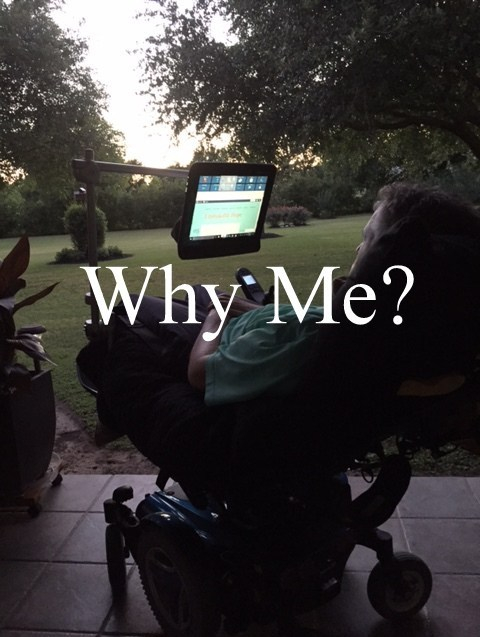
But, I’ve learned that our motive behind asking this seemingly simple question says a lot about how we view God – and also a lot about how we view ourselves.
The first man asks the question like this: “Why me; out of 7 billion people in the world, why did I get ALS (or whatever)?”
He’s really asking, “Why didn’t God put this horrible trial on one of the other 7 billion people?”
This man has a warped view of God and an exalted view of himself. He views his trial as pointless, and he thinks that he should somehow be exempt from the suffering of humanity.
I know what I said about this first man sounds harsh and judgmental, but I know this man well; in a spiritual and emotional sense, I wrestled with him for several months after being diagnosed with ALS.
Thankfully, with the help of God’s word, wise counsel from Christian friends and a well-timed conversation with our non-Christian next-door neighbors, I began to see that there might be a purpose, an eternal purpose, behind my trial. I defeated that “woe is me” man who was fighting to take control of my thoughts and emotions. (More about our next-door neighbors further down).
The second man asks the question like this: “Why me; what’s God’s purpose behind allowing this horrible trial?”
This man has the correct view of God and of his place in the world. As a Christian, this man knows that God wouldn’t have allowed this trial unless He had a greater purpose, a purpose that outweighs the suffering this man would have to endure (from his trial).
“And we know that God causes all things to work together for good to those who love God, to those who are called according to His purpose.” (Romans 8:28)
That verse can only be true if we have an eternal (“Big Picture”) view of our trial. God still heals and performs miracles, and I believe that we should always pray for that result. (Never give up on God doing miracles!)
Regardless of the outcome, God can bring about eternal good from every trial.
In a hundred years, the eternal good that comes from our trial will be the only thing that matters.
A difficult trial (usually) causes the Christian to focus more on the spiritual and the eternal things because, by comparison, the temporal and the material things begin to look more and more insignificant.
Back to our next-door neighbors: Mike and Lorraine were not followers of Christ when we met them. Of course, we did our Christian duty and invited them to church and tried to share the “Good news” with them. Even our girls (then 4 and 7) invited them to church, but all to no avail.
Mike and Lorraine later told us that they mocked us in private. I told them that I could relate because, before making a commitment to follow Christ, I mocked Christians too. Let’s be honest, making fun of Christians is so easy.
But, after I was diagnosed, Mike and Lorraine began to reexamine the faith that was sustaining our family through this trial. Lorraine told me:
“…When you were diagnosed with ALS I began to see a man who held no anger with the God that ‘allowed’ this to happen. Then you began to demonstrate trust in God’s plan. I saw your faith and I saw two little girls accept what God was doing in your lives and I began to wonder how such young children could love God unconditionally. I opened my heart first to the possibility that this might be a good thing for me as well. Then I finally got it and allowed my brain to accept the basic truth that God is only good, loving and faithful…”
Mike and Lorraine made a commitment to follow Christ and faithfully attend church and share their faith with others. (Now people probably make fun of them).
Would Mike and Lorraine have made a commitment to follow Christ if we had not gone through this trial? Obviously, only God knows the answer to questions like this. The only thing I know for sure is that this trial has strengthened my faith and has also given me more confidence in sharing that faith.
But, I admit that difficult trials can feel like you’re serving a prison sentence, especially when you have ALS and you’re imprisoned in your own body. However, the Apostle Paul wrote much of the New Testament while imprisoned. And, many of his fellow prisoners and the guards that observed Paul, became followers of Christ. Only Jesus can spread a message of hope through a prisoner – this is truly Unshakable Hope!
UPDATE: Sadly, Mike went through a long battle with cancer and is now with Christ in heaven. I am looking forward to seeing him again.
I hope I’ll see you there also.
“Now I want you to know, brethren, that my circumstances have turned out for the greater progress of the gospel, so that my imprisonment in the cause of Christ has become well known throughout the whole praetorian guard and to everyone else, and that most of the brethren, trusting in the Lord because of my imprisonment, have far more courage to speak the word of God without fear.” (Philippians 1:12-14)
(I have made changes to my blog, please let me know if you are having problems with it loading…)
Having the Right Perspective
I’ve discovered how essential it is to keep things in perspective in order to maintain hope when you’re in the midst of a trial. The first and most important lesson I learned was focusing on what I have and not on what I’ve lost.

Our family before I was diagnosed with ALS. (Mary still had BIG hair).
Perspective: the capacity to view things in their true relations or relative importance. (Webster’s Dictionary)
I know of many people close to my age, even some close friends, who have died of ALS, Cancer and other diseases or were killed in tragic accidents. These moms and dads have missed being able see their children growing up. They weren’t there to take pictures before prom, to watch with pride as their child graduated from high school and/or college or to witness their son or daughter’s wedding.
I force myself to think about these friends and acquaintances when I begin feeling depressed about my inability to fully participate in this thing we call life. At times like last year when my daughter got married, and I was unable to walk her down the aisle or dance with her at the reception. During difficult times like this, I make a conscious effort to think about some of these people that are no longer with us; people like my friend Rick, who died of Cancer, leaving a wife and two teenage sons. I think about another blogger named Patrick, who died of ALS in December leaving a wife and a teenage son and daughter. Sadly, Rick and Patrick won’t get the opportunity to watch with pride as their children go through graduations, weddings and other landmark events in their lives.
I think about these people every time I’m tempted to complain or get depressed about my situation. I ask myself what they’d say to me if I was to complain about things like not being able to walk my daughter down the aisle at her wedding. Would they tell me that I should be grateful for just getting to be there to watch as she walked down the aisle? Of course, Rick, Patrick and the others have gone on to heaven so I don’t know what they might say to me. But I know they would be right if they were able to tell me to be grateful that I was able to be there for all the events that they’ve missed and will miss. In a sense, I feel that I owe them; that, if for no other reason, I must be grateful for their sake.

Our son-in-law and daughters (January, 2012).
I know it’s strange for me to imagine what deceased people might say to me (to give me the proper perspective), but it works for me and, regardless of the trial that you find yourself in, we all must find ways of coping; ways of changing our perspective and attitude – ways of convincing ourselves that our life isn’t so bad after all.
“…I have learned to be content in whatever circumstances I am.” (Philippians 4:11)
The aim of every Christian should be learning to be content in the good times and in the bad times. But, for those that hope in God, contentment does not mean we stop believing for better days ahead; it just means we’re grateful for today and that we’re going to live it to the full – even if we have to live today in a wheelchair!

“For in hope we have been saved, but hope that is seen is not hope; for who hopes for what he already sees? But if we hope for what we do not see, with perseverance we wait eagerly for it.” (Romans 8:24-25)
Don’t give up!
After reading some of the comments from my last post (“More than just a Dream”), I’m afraid that I might have left the impression that my only hope (for physical healing) is in the next life. If I believed heaven was my only hope for healing, I probably would have checked out years ago. Waiting (for heaven) to be healed is merely my backup plan; it’s my Plan B. Whether it’s through medical science or a miracle from God, even after 16 years with ALS, I’m still hoping for the best outcome here on earth. This is what I believe for others too, regardless of the severity of their trial.
I realize how crazy it sounds for someone who has received a diagnosis of ALS to be hoping for a complete recovery. I’m not naïve; I’ve known so many good Christian people who have died of this and other insidious diseases like Cancer, Heart Disease and Lupus. And I realize that, medically speaking, ALS is 100 percent fatal. Well, technically that’s not true; there are medically documented cases of people being miraculously healed of ALS and even the ALS Association says, “There are people in whom ALS has stopped progressing and a small number of people in whom the symptoms of ALS reversed.” So maybe it’s only like 99.9 percent fatal – I choose to believe for that one tenth of one percent chance.
As I typed that, a scene from the movie Dumb and Dumber came to my mind (don’t judge me). In this scene, one of the “dumb guy’s” named “Lloyd,” who’s in love with a beautiful and sophisticated character named “Mary,” is asking her what the chances of them ending up together are:
Lloyd: What do you think the chances are of a guy like you and a girl like me… ending up together?
Mary: Well, Lloyd, that’s difficult to say. I mean, we don’t really…
Lloyd: Hit me with it! Just give it to me straight! I came a long way just to see you, Mary. The least you can do is level with me. What are my chances?
Mary: Not good.
Lloyd: You mean, not good like one out of a hundred?
Mary: I’d say more like one out of a million.
[pause]
Lloyd: So you’re telling me there’s a chance… *YEAH!*
Maybe some of you reading this think I’m like Lloyd for being excited about a one in a million chance of being healed of ALS. Maybe you’re thinking that I shouldn’t encourage people to hold onto “false hope.” I’m definitely not the sharpest knife in the drawer, but I’m not “Lloyd” either; I’ve been contemplating this for over 16 years and here are some of my conclusions:
- Miracles by definition defy all natural laws – including statistical probabilities.
- For the 16+ years of this trial, God has sustained us with miracle after miracle; I don’t think I have the right, nor do I think that I’m qualified to categorize certain miracles as “big” and others as “small.”
- There’s no such thing as “false hope” when you’re looking to the “God of hope.”
- Jesus still heals; He “is the same yesterday and today and forever.” (Heb13:8)
- “God doesn’t show partiality.” (Acts 10:34)
- “The things that are impossible with people are possible with God.” (Luke 18:27)
- I would rather die looking for a miracle than live not believing in them.
In Daniel chapter 3, King Nebuchadnezzar demanded that the Jews bow down and worship his god. All those that refused to bow would be thrown into the furnace that the Babylonians used to make bricks. As most people know, three young Jewish men refused to bow and this is what they told the king; “…our God whom we serve is able to deliver us from the furnace of blazing fire; and He will deliver us out of your hand, O king. But even if He does not, let it be known to you, O king, that we are not going to serve your gods or worship the golden image that you have set up.”
For me, this is more than a great example of strong faith; I believe this is a pattern of faith that all Christians should emulate regardless of challenges we might be facing. We can proclaim that, “Our God whom we serve is able to deliver us from [insert your trial here]. BUT EVEN IF HE DOES NOT… we are not going to serve…” doubt, fear, worry, hopelessness or anything else that destroys faith, hope, joy and peace!
More than just a dream
I had a vivid dream last night – In this dream I was completely healed and whole.
The dream began with me simply stepping out of bed, which is something I haven’t been able to do in over 15 years. I could walk, talk, eat, dress myself and do everything else that I was once able to do. Mary and I were so excited that we began calling all of our family and friends and then we began visiting people at their homes and offices (Mary drove the car because I don’t have a driver’s license and the only thing I’ve driven in last 15 years is a wheelchair).
The dream was so real-to-life that I was telling Mary all the places I wanted to travel to and all the restaurants I wanted to try. I was even making practical plans like getting a driver’s license and making an appointment with the doctor to have my feeding tube removed etc. As you can probably imagine, this was so exciting; more so than winning a billion dollar lottery! But that incredible excitement soon turned to great disappointment when I awoke from this vivid dream at 4:15 this morning and realized I couldn’t even uncross my feet, let alone get out of bed.
Then my great disappointment turned back into incredible excitement when I remembered that, regardless of what happens in this life, one day I KNOW that I WILL be healed and whole! One day “…there will no longer be any death; there will no longer be any mourning, or crying, or pain…” (Revelation 21:4)
There was a time in my life that I feared death and the unknown in general. I later found out that these fears are quite common. But, as strange as it might sound, ever since I committed to following Christ and began believing the promises of God’s word, my fear of death has been replaced with an excitement of what lies in store for me after this brief and fragile life is over. Christ died and rose again to free us from sin AND from the fear of what lies ahead – “…only by dying could He (Jesus) break the power of the Devil, who had the power of death. Only in this way could he deliver those who have lived all their lives as slaves to the fear of dying.” (Hebrews 2:14-15 NLT)
What would you do if…?
One night, about a year before I was diagnosed with ALS, Mary and I were up late watching “Nightline.” Ted Koppel was doing three nights of interviews with a retired college professor named Morrie Schwartz. Morrie had ALS and was sharing his life-lessons with Ted Koppel just as he had done previously with one of his former students named Mitch Albom. Mitch later compiled these life-lessons and wrote a best-selling book titled “Tuesdays with Morrie.”
I hate to admit this, but even after seeing the three nights of interviews and reading the book, I cannot remember most of the life-lessons that Morrie taught. But, I do have one vivid memory from watching those interviews; it occurred while listening to Morrie describe his daily routine – having to rely on his wife and caregivers for virtually all of his needs. After hearing how helpless he was, I turned to Mary and told her I would rather just go to heaven than live trapped in my own body like him.
About a year after making that statement, I was diagnosed with that same “trapped-in-your-own-body” disease. While I believe words are powerful and can even be self-fulfilling (“Death and life are in the power of the tongue…” Proverbs 18:21), I don’t believe my statement had anything to do with my being diagnosed with the same disease the following year, but…
That hastily-made statement began to haunt and even taunt me when I began needing help from Mary with things I once did with little effort. The statement kept playing over and over in my head, challenging me to either disavow my words or live up to them. In this case, living up to my words meant throwing in the towel and going to heaven.
Obviously I chose to change my view and began trying to do my best to live one day at a time. But it wasn’t really me that decided to carry on; it was the grace of God in me, urging me to keep going. Not like a coach on the sidelines shouting, but more like the team captain competing alongside of me. It was then I knew the full meaning of verses like, “My grace is sufficient for you, for power is perfected in weakness.” (2 Corinthians 12:9).
Hastily-made statements (like the one I made about Morrie) that are carelessly uttered by healthy people (like I was) are spoken out of pride. Pride is something we usually don’t know we’re guilty of before being humbled by a severe trial. Pride cannot comprehend the grace of God because pride is self-reliant, self-righteous and just plain selfish. God’s grace (to carry us through a trial) is one of the things people usually don’t factor in before making such statements.
Another thing people (who make statements like that) don’t consider or even understand, is how strong our God-given survival instinct is. Not merely for our physical survival, but also for our emotional and spiritual survival. This is an ironic thing because it would seem that a Christian (who believes in heaven) would be the first to cash in his chips, but the opposite is true. It is usually those that don’t believe in an after-life that judge the quality of their lives by physical, financial and other temporal pursuits and who cannot imagine a life worth living without these things. But the believer can know joy, peace, hope and have a sense of purpose without the worldly blessings. Of course, it’s always best to have both spiritual and earthly blessings, but, to the Christian, the former are essential and the latter are viewed merely as “bonuses.”
Trials cause us to reexamine the hastily-made statements we’ve made before the trial, when we so carelessly said what we’d do if this thing or that thing happened to us. As I discovered, no one really knows what they would do until faced with that situation. This is why the Bible tells us to “be slow to speak” (James 1:19).
This is the only advantage I’ve discovered from losing the ability to speak; I no longer say things that I regret!
 Unshakable Hope