Blog Archives
What Are You Seeking?
I follow a Bible reading plan every year, and the plan I’m following this year begins with John’s Gospel. I’ve always thought it was much more than a coincidence that the first words spoken by Jesus (in John’s Gospel) come in the form of a very profound question; it’s a question that everyone should know the answer to:
“What are you seeking? (John 1:38)
When I read that question on January 1st, I paused to think about what I should be seeking this year. I believe that our New Year’s Resolutions, or lack of, tell a lot about what we’re seeking. The following is a list of the top ten New Year’s Resolutions for 2014. Other than showing that we smoke too much, spend too much, sit too much and eat too much, what does this list tell us about the American people?
- Lose weight.
- Improve finances.
- Exercise more.
- Get a new/better job.
- Eat healthier.
- Manage stress better.
- Quit smoking.
- Improve a relationship.
- Quit procrastinating.
- Set aside time for yourself.
Besides being obsessed with our bodies and being guilt-ridden over repeatedly doing the things we don’t like, it seems to me that we’re focused on treating symptoms instead of the disease. I think all of these resolutions are good, but notice that none of the top 10 resolutions are in any way spiritual. Maybe that’s why only around ten percent of those that make resolutions succeed in keeping them. And of that ten percent that succeeds at conquering a habit or addiction, a large percentage of those will simply replace that habit or addiction with an equally destructive behavior. It seems that we’re trying, and mostly failing, to fight the flesh with the flesh.
Jesus and the Apostles tell us that we should be seeking the things which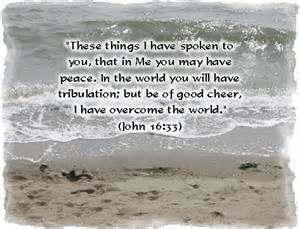 lead to peace. Not “world peace,” but our inner-peace. I’m not a psychiatrist or an addiction counselor, but it seems to me that a lack of inner-peace is at least partially, if not mostly, to blame for the majority of our bad habits, addictions, bad attitudes and other negative behaviors.
“For the mind set on the flesh is death, but the mind set on the Spirit is life and peace…” “So then we pursue the things which make for peace and the building up of one another.” (Romans 8:6 & 14:19)
I haven’t yet perfected this inner-peace thing, but I’ve come a long way over the last ten or fifteen years. I’ve discovered that seeking peace through doing things like reading the Bible, prayer, listening to sermons and having like-minded friends, including blog friends, will greatly increase our sense of peace. If our primary focus is on seeking peace—the Prince of peace, we make Christ our partner in overcoming addictions and bad habits and bad attitudes.
“Be anxious for nothing, but in everything by prayer and supplication with thanksgiving let your requests be made known to God. And the peace of God, which surpasses all comprehension, will guard your hearts and your minds in Christ Jesus.” (Philippians 4:6-7)
Even if you’ve already broken your resolutions, reset your priorities and start over again. Make seeking peace your number one goal and it will increase your joy and hope and give you the strength to conquer your “demons.”
“Now may the God of hope fill you with all joy and peace in believing, so that you will abound in hope by the power of the Holy Spirit.” (Romans 15:13)
The Greatest Christian I Know
Who is the greatest Christian you know?
I will give my answer to that question at the end of this post.
I realize that questions such as this could be classified by some as judging others. But the Bible does tell us to “test ourselves” (2 Corinthians 13:5) and to test spiritual claims and people (1 John 4:1 & Revelation 2:2). The Bible also gives us attributes to look for when conducting these examinations of ourselves and others.
Here are some of the attributes (of great Christians) that I’ve found in the Bible:
- Compassionate, Kind, Humble, Gentle, Patient, Bearing the burdens of others and Forgiving (Colossians 3:12-13)
- Encouraging and Building-up others (1 Thessalonians 5:11).
- A reader and a “doer” of God’s word (James 1:22).
- Hospitable, Sensible, Just, Devout and Self-controlled (Titus 1:8).
- Loving, Joyful, Peaceful, Faithful (Galatians 5:22)
- Prayerful, Thankful (to God and others) and Hopeful (Colossians 1:3-5).
If you tested yourself by the above criteria and concluded that you deserve an A+ on every one these virtues, you’re either delusional or off-the-charts self-righteous. Everyone, even the person I chose as “The Greatest Christian I Know,” struggle with some of these.
But, according to Jesus, a truly great Christian possesses one quality that sets them apart; “But the greatest among you shall be your servant.” (Matthew 23:11)
![“True greatness, true leadership, is achieved not by reducing [people] to one’s service, but by giving up oneself in selfless service to them.” Oswald Chambers](https://unshakablehope.com/wp-content/uploads/2013/10/servant.jpg)
“True greatness, true leadership, is achieved not by reducing [people] to one’s service, but by giving up oneself in selfless service to them.” Oswald Chambers
I think of people like my sister and her husband who care for their 18 year-old severely Autistic son. People like my mother-in-law who took care of her ill husband until he recently passed away. And even paid caregivers, like the woman that helps Mary take care of me, qualify as “Great” in my book.
But the Greatest all-around Christian I know is Mary, my wife and best friend of 28 years. Since being diagnosed with ALS years-ago, she’s also been my full-time caregiver. She is the best example I know of a truly selfless servant.
And, no, I didn’t just choose her as the greatest Christian out of fear that she’d stop feeding and clothing me.
“…whoever wishes to become great among you shall be your servant, and whoever wishes to be first among you shall be your slave; just as the Son of Man did not come to be served, but to serve…” (Matthew 20:26-28)
Prioritizing Our Hopes
When you go through a trial, especially an extended trial that disrupts or even destroys your earthly hopes and dreams, you either learn to focus and depend more on your eternal hope or slide further into despair.
I imagine that every Christian that has gone through an extended trial will remember coming to this difficult crossroad and facing this choice. In truth,  it’s a decision we should have made when we committed to follow Christ – whether or not we were going through a trial at the time. By definition, a Christian is someone whose primary hope is an eternal hope in Christ.
“…we who have taken refuge would have strong encouragement to take hold of the hope set before us. This hope we have as an anchor of the soul, a hope both sure and steadfast…” (Hebrews 6:18-20)
I know that God wants us to have hopes in and for this life, but, for the Christian, those hopes must be secondary to our heavenly hope. Our heavenly hope must govern our earthly hopes. This is the only formula that leads to the “Abundant life” that the Bible talks about. If Jesus is not the Christian’s primary hope, he or she will have a really difficult time when (not if) a trial comes. Even when everything is going great (by the world’s standards), the Christian that does not have his or her hopes in order will not be experiencing the inner joy and peace that the Bible tells us we should have.
Unfortunately I speak from experience. If asked, I probably would have said that eternity was my primary hope before being diagnosed with ALS, but  looking back now I really don’t think it was. It’s so easy to get caught up in our career, our marriage, raising kids, our homes and so many other things involved in day-to-day life that, without even realizing it, our earthly hopes and dreams can become our primary focus.
In this context, I think it’s fair to say that hope and love are synonymous. If Christ isn’t our primary hope, He is not what the Bible calls “our first (most important) love” either. I remember when I began reading the Bible, I had a real hard time with the following verse: “He who loves father or mother more than Me is not worthy of Me; and he who loves son or daughter more than Me is not worthy of Me.” (Matthew 10:37)
Probably because I didn’t understand Christ’s nature at that time, His demand seemed harsh and even narcissistic. After reading the whole New Testament and getting a better understanding of His selfless nature, I realized that His demand had nothing to do with harshness or ego; it is a simple matter of priorities. It’s only by loving Christ more than anyone or anything that we are able to demonstrate His unconditional love to and for others. Likewise, it’s only when Christ is our greatest hope that we are able to fully appreciate and enjoy our earthly hopes. And, it’s only when Christ is our primary hope that we will know if our secondary hopes are also God’s hopes for us.
Pacing Your Productivity
Our 24 year old daughter, Lauren, is a blogger too; she posts with a group of women at http://sozowomen.com/. I thought I would share her latest post with you.
I have an addiction. It causes me to be on an emotional and energetic high, but when it is all said and done, at the end of the day, I am left exhausted and sitting in a big heap of unrest and heaviness. It’s an addiction that comes in all forms, to all personalities, and all life stages. For me, it has looked different in every season of life but somehow leaves me with the same end results. Ok, I’ll just say it: I am addicted to productivity. I am addicted to my to-do list, in how much and how well I can accomplish, do, create, become.

“That’s a great thing to be addicted to,” I hear others, “at least you get things done!” Well, no, I have realized that although productivity gives me a buzz in the moment, I can’t seek God at the same time. This is where the challenge lies. As I quiet my soul and take my mind off “to-doing”, I find a complete indirect correlation between my productivity addiction and those infamous words that Jesus whispers in my ear. They creep up in my heart and strike a chord—comforting, yet painful.
“Come to me, all who labor and are heavy laden, and I will give you rest. Take my yoke upon you, and learn from me, for I am gentle and lowly in heart, and you will find rest for your souls. For my yoke is easy, and my burden is light.”
-Matthew 11:28-30, ESV
Don’t get me wrong, productivity is good. God loves it (have you read Proverbs 31, yikes!), but when it pulls us away from resting in Him, stealing our peace, we labor (toil, strive) and are heavy laden (burdened, weary). As I read those few verses above, I want to scream, “That’s me! He came for me! He understands!” He came for the weak, the heavy hearted, the one who doesn’t necessarily know how to “find” Him.
We are all on a journey to learn how to constantly hold Jesus’ hand as we walk throughout each day, to find Him in the secret place, to be whole and complete in Him. Would you join me on this journey? I am going to use these 3 practicals to help me along:
- Slow Down.
- Pray over your to-do list and what the day holds.
- Every time you find yourself focusing on all you need “to do” or heavy situations in life, refocus your mind on Jesus and maybe find a verse (or this one above) to hold on to.
In what ways do you find yourself losing peace? In what ways do you learn to find peace in the midst of labor and busyness?

I’m thinking Lauren will get some help overcoming productivity when the baby arrives.
One Day At A Time
At the beginning of this trial, so many people, mostly long-time Christians, would advise me to “Just take one day at a time.” I’m sure that every one of these wise people thought they were the first to give me this sage advice. Of course, I always acted as if they were the first to give me that advice and I politely thanked them. (If you are one of those that offered me this advice 16+ years ago, I’m sorry I didn’t tell you that a hundred people already gave me that same advice).
To be honest, even though a hundred people repeated this “Take one day at a time” cliché to me, I really didn’t understand at that time exactly what it meant. Like so many clichés, I think people throw them out to fill dead air space in awkward moments when they have nothing else to say. But, I now know this advice is much more than a wise-sounding cliché and the title of an old Southern Gospel song; I discovered it’s also a Biblical principle.
Let me explain how I came to this conclusion.
The Christian going through a trial will quickly figure out something they wish that they’d known all along—today is all that we can properly manage or were meant to manage. Agonizing over our yesterdays and worrying about our tomorrows is just too great of a burden to carry; it will literally overwhelm us emotionally, spiritually and even physically.

In chapter sixteen of the book of Exodus, while in the wilderness (a Biblical metaphor of a trial), God fed the children of Israel with Manna. Jesus said that Manna was “bread that came down out of heaven.” This bread had a very short expiration date; it was only good for that day. If you attempted to put it in a Ziploc bag to save it for the following day, as some tried to do, it would spoil and you’d find maggots crawling on it. God was trying to teach them to trust Him only for today—yesterday’s “bread” is useless (unless you like maggot protein) and tomorrow’s bread hasn’t yet been delivered.
“Give us this day our daily bread.” (Matthew 6:11)
The Old Testament uses “types and shadows” of things to come when the Messiah arrived. As Jesus said; “Do not think that I came to abolish the Law or the Prophets; I did not come to abolish but to fulfill.” (Matthew 5:17)
Manna was a type and shadow of Jesus; He’s our daily bread—our spiritual sustenance; “I am the bread of life. Your fathers ate the manna in the wilderness, and they died…I am the living bread that came down out of heaven; if anyone eats of this bread, he will live forever; and the bread also which I will give for the life of the world is My flesh.” (John 6:48-51)
In a very real sense, the life of faith in Christ is only about today; we’re told to forget about yesterday and not to worry about tomorrow:
“…one thing I do: forgetting what lies behind and reaching forward to what lies ahead, I press on toward the goal for the prize of the upward call of God in Christ Jesus.” (Philippians 3:13-14)
[Between these two passages is a day we call “today.”]
“So do not worry about tomorrow; for tomorrow will care for itself. Each day has enough trouble of its own.” (Matthew 6:34)
I believe that we should do everything within our power to resolve our past (asking God and those we’ve wronged for forgiveness, paying our debts, etc.) and to plan for our future. But I don’t believe that God designed us to carry guilt from our past or to worry about our futures. Christ suffered and died to offer us forgiveness of our past and to secure our eternal futures in heaven. Knowing this puts our earthly troubles in perspective. We can live in peace, joy and hope one day at a time because: “Jesus Christ is the same yesterday and today and forever.” (Hebrews 13:8)
This I recall to my mind, therefore I have hope. It is of the Lord’s mercies that we are not consumed, because his compassions fail not. (Like Manna) They are new every morning: great is thy faithfulness. (Lamentations 3:21-23)
 Unshakable Hope