Blog Archives
TGIF
I was thinking about Good Friday when I woke up early yesterday morning. Then I thought about people using the phrase “Thank God It’s Friday” to celebrate the end of a work week and the start of the weekend.
Even though I haven’t worked in over 19 years, I remember that feeling of being so glad a work week was over as I was sitting in bumper-to-bumper traffic on a Friday evening or landing at the airport after being gone all week on a business trip.
Then I thought about the darkest Friday of my life.
After three days of grueling tests, which included cutting muscle samples out of my thigh without any anesthetic and a spinal tap that left me with a debilitating headache for three days, the neurologist, flanked by a group of interns, told to Mary and I that I had ALS. He went on to say that I would continually get weaker, be confined to a wheelchair, lose my ability to speak, and that I would die in three to five years.
That was not a Friday I was thanking God for.
Do you think when the disciples were staring up at Jesus dying on the cross they called that day “Good Friday?”
Yeah, I don’t think so either.
I’m sure there was a lot of confusion and crying on that dark day. Maybe they were like Mary and I on the long drive home from the medical center that Friday evening; not even looking at one another for fear of dissolving into tears.
Like Mary and I, I’m sure they were thinking, “This isn’t the way it was supposed to be.”
To add insult to injury, Jesus and the disciples were surrounded by people that were mocking and celebrating His crucifixion.
For the disciples, this day was anything but TGIF.
Jesus knew differently.
“…for the joy set before Him (Jesus) endured the cross…” (Hebrews 12:2)
It was “for the joy set before Him” that Jesus was able to endure the insults, the flogging, the beatings, and being nailed to the cross.
It wasn’t until Sunday morning that the disciples understood that God’s plan was so much bigger and better than they could have imagined:

“…let us run with endurance the race that is set before us, fixing our eyes on Jesus, the author and perfecter of faith, who (like Jesus) for the joy set before Him endured the cross…” (Hebrews 12:1-2)
We can endure the cross we have to bear, no matter how heavy it might be, if we “fix our eyes on Jesus” and focus on “the joy set before us” – eternal life with the One who suffered and died for us.
This does not mean that we have to abandon our hopes and dreams for this life – far from it. God wants to bless us in this life too.
But, making a commitment to follow Christ is the only Unshakable Hope that God offers for this life and the next.
Today is a great day to make this commitment or to renew your commitment.

The Will To Live
I almost made it through a whole year without being hospitalized or having any additional health problems. Almost. Then, with just a few days left in 2016, I caught a cold. The “common cold” is not much more than an annoyance for otherwise healthy people, but for someone like me with weakened breathing muscles and only 30% of my lungs functioning, the common cold is much more than an annoyance.
On the morning of the last day of the year, I was having an extremely difficult time breathing even wearing my breathing mask. In addition to that, I couldn’t keep anything down. I was a mess, more than usual. Mary and I both assumed it was pneumonia again so she called 911 and within minutes we were in an ambulance en route to the hospital. ALS has brought us one adventure after another over the last 20 years.
We waited in a small emergency room for twelve hours while waiting for a room to open so I could be admitted. It was during this time that I began thinking about the will to live. I was thinking, “if I didn’t have a sense that God still had a purpose for even a broken down mess like me or if I was an atheist or adhered to some other fatalistic worldview, I would have wanted a doctor to give me a shot that would have ended this suffering. It was as if my opposition to euthanasia was being tested.

If you are convinced you’re going to heaven, where the Bible says there will be no more pain, suffering and tears…, why continue to go on fighting to live?
Apart from the fact that the Bible teaches that life, including our own life, isn’t ours to take, it’s a very logical question; a question I’ve pondered at length over the last 20 years.
It’s a question that really confuses atheists.
Years ago I was watching a Barbara Walters special on heaven. She interviewed representatives of many different faiths to get their take on the after life. For some reason her last interview was with an atheist. I remember so vividly the closing sentence of this atheist: (If we believed in a heaven) “we’d all be killing ourselves now.”
But the reverse puzzles me: if atheists believe that this short life is all that there is, why do studies on assisted suicide show that atheists are the most likely to choose that option when facing a terminal illness?
Last year, Mary and I watched a movie titled “Me Before You.” It was a fictional “love story” about a wealthy self-centered 33 year old playboy in England that becomes a quadriplegic after a tragic accident. He’s obviously depressed and becomes a recluse in his parents mansion. He begins researching assisted suicide and finds a beautiful facility in Switzerland that provides “death with dignity” for wealthy people from all over the world (unfortunately, this facility really exists).
I’m obviously not a movie reviewer so let me wrap this summary up: his pretty young caregiver convinces him to travel to many exotic locations and they fall in love, but he still goes through with his plan to end their travels at the Switzerland death clinic. Not a very happy ending.
While watching this “love story,” my mind began to wander. I began thinking about a woman I admire so much. Fifty years ago, this woman was a beautiful and carefree 17 year old swimming with friends in the Chesapeake Bay. She dove into shallow water and hit bottom. This tragic accident resulted in her becoming a quadriplegic, virtually the exact same injury as the man depicted in the movie. Like him, she became depressed, reclusive and also had suicidal thoughts, but…
Joni Eareckson Tada had made a commitment to follow Christ three years earlier while attending a Christian summer camp. It was a renewal of this commitment and the support of family and friends that gave her life new purpose. For 50 years she’s been serving others all over the world while confined to a wheelchair. She shares the Gospel on TV and radio, hosts summer camps for mentally and physically disabled youth and, a ministry that is so needed, she provides wheelchairs to the disabled in third-world countries, like the boy below in Haiti. Her ministry has given away over 150,000 wheelchairs so far.

It’s really amazing what God can do with broken (humbled) vessels, regardless of our physical state. This year, give God permission to use you – this is the ultimate expression of His gift of a freewill. We are Christ’s hands to help a hurting world.
And, as the Apostle Paul wrote, when we’re done fulfilling God’s purpose for us in this life, it gets so much better:
“For me, to live is Christ and to die is gain.” (Philippians 1:21)

No matter how depressed you might be over your current circumstances, please don’t give up, your story doesn’t have to have a sad ending.
“Therefore we do not lose heart (don’t give up). Though outwardly we are wasting away, yet inwardly we are being renewed day by day.” (2 Corinthians 4:16)

Opportunities In Trials
In the midst of a trial, the greatest temptation we face is to hunker down and wait for the storm to pass. I don’t believe this is ever God’s will.
We tend to view trials as a kind of imprisonment, thinking our life is on hold until the day we’re released from the grip of the life challenge. ALS has made me a virtual prisoner of my own body for the last 18 years. It has been a very cruel warden. But I look around me and see other people fighting illness or trying to overcome addictions, depression, abuse, debt and so many other cruel masters.
We must continue to hope and pray for freedom from whatever is trying to “hold us,” and we should do everything in our power to move toward that goal. But, in the meantime, we should look for opportunities for God to use us right where we are. This is what the Apostle Paul did, and I’m convinced it’s what God wants us to do.
It was from prison that Paul wrote the following: “Now I want you to know, brethren, that my circumstances have turned out for the greater progress of the gospel…” (Philippians 1:12)
We don’t usually associate the word “progress” with imprisonment or any kind of trial, but I believe that we should. If we wait until we “have it all together” before we try to help and give hope to others, many will go without help and die without hope.
Would I be a hypocrite telling people that God still heals when I’ve been held in the grip of a terminal disease for 18 years?
Let me answer that with another question: Was Paul a hypocrite for writing about freedom in Christ from the depths of what was likely a rat infested dungeon?
Paul was almost stoned to death by an angry mob and severely beaten other times. He also suffered from what he called “a thorn in his flesh” (many Bible scholars say this “thorn” was poor eye sight). Regardless, it’s unlikely that Paul was the handsome and strong man depicted in the Bible movies. After spending much of his time in prison and enduring countless beatings, he was likely pale and scarred, and probably in pain 24/7. Yet, God used this suffering servant to heal and give hope to others.
The Apostles faced the same trials, temptations and human frailties that we face. Yet, in the midst of trying to overcome their own trials and temptations and battling their own demons, they were feeding the poor, healing the sick and giving hope to others by spreading the good news.
People don’t care about how much we know until they know how much we care. Maybe we wouldn’t have truly learned to care apart from our suffering.
I hope you’re successful in keeping all of your New Year’s Resolutions, and 2015 is the best year you’ve had so far. But we cannot wait for all of our hopes to be fulfilled before we offer help and hope to others.

We overcome as we help others to overcome.
Thinking About Death
When I was a kid, I had a friend I’ll call “Bubba.” (There were no kids called Bubba where I grew up so I figure that’s a safe name to go with). Bubba was a high-maintenance friend that never called before coming over and always seemed to show up at my house when I was in the middle of doing something important, like watching Gilligan’s Island. He was hyper and never stopped jabbering on about stuff I wasn’t the least bit interested in. No matter how disinterested I acted, he would stay for hours and would even invite himself to dinner. To my immature and selfish mind, Bubba was annoying.
Before becoming a follower of Christ, I viewed thoughts and discussions about death much like I viewed Bubba knocking at my door – an unwelcome annoyance. After becoming a follower of Christ and coming to believe that my eternity in heaven was secured, I basically put the issue of death on a shelf thinking that one day, when I was old and gray, I would have to take it down, dust it off and deal with it. Even as a Christian, I still viewed death as “Bubba.” I never thought that welcoming death into my thoughts and prayers every day would be one of the best decisions of my life.
Old age, tragic accidents and horrible illnesses remind us that invincibility (in these bodies) is a  myth; we are deceiving ourselves. ALS jolted me out of that denial comfort zone and forced me to face death head on and it’s been the most life-transforming experience. I hope to convince others that thinking about death on a daily basis is good for us emotionally and spiritually. This is the exact opposite of what I believed before ALS invaded my life.
“…we had the sentence of death within ourselves so that we would not trust in ourselves, but in God who raises the dead…” (1 Corinthians 1:9)
A few months ago I read an article that listed the top 5 regrets of the dying. They are as follows:
I wish I’d had the courage to live a life true to myself, not the life others expected of me.
I wish I hadn’t worked so hard.
I wish I’d had the courage to express my feelings.
I wish I had stayed in touch with friends (Bubba, where are you?)
I wish that I had let myself be happier.
I suppose everyone’s list of deathbed regrets would vary from the above list, but in truth we’ll only have one regret on our deathbed: “I wish that I hadn’t lived in denial that this day would come.” All of our regrets grow out of denial about our death. One would think, as I once thought, that thinking about our death, putting ourselves on our deathbed, every day would be depressing, but I’ve discovered that the opposite is true.
 Like me, Ebenezer Scrooge wasn’t changed by reflecting on his past or even by discovering how others viewed him; he was only transformed when he came to terms with his own mortality. Obviously “A Christmas Carol” is not based on the Bible, but I believe Dickens got that part right.
“…that I may know Him and the power of His resurrection and the fellowship of His sufferings, being conformed to His death…forgetting what lies behind and reaching forward to what lies ahead…” (Philippians 3)
We rightly associate Easter with life, but Jesus’ whole mission was about defeating death. He had to face death before He could defeat it and so must we.
What Are You Seeking?
I follow a Bible reading plan every year, and the plan I’m following this year begins with John’s Gospel. I’ve always thought it was much more than a coincidence that the first words spoken by Jesus (in John’s Gospel) come in the form of a very profound question; it’s a question that everyone should know the answer to:
“What are you seeking? (John 1:38)
When I read that question on January 1st, I paused to think about what I should be seeking this year. I believe that our New Year’s Resolutions, or lack of, tell a lot about what we’re seeking. The following is a list of the top ten New Year’s Resolutions for 2014. Other than showing that we smoke too much, spend too much, sit too much and eat too much, what does this list tell us about the American people?
- Lose weight.
- Improve finances.
- Exercise more.
- Get a new/better job.
- Eat healthier.
- Manage stress better.
- Quit smoking.
- Improve a relationship.
- Quit procrastinating.
- Set aside time for yourself.
Besides being obsessed with our bodies and being guilt-ridden over repeatedly doing the things we don’t like, it seems to me that we’re focused on treating symptoms instead of the disease. I think all of these resolutions are good, but notice that none of the top 10 resolutions are in any way spiritual. Maybe that’s why only around ten percent of those that make resolutions succeed in keeping them. And of that ten percent that succeeds at conquering a habit or addiction, a large percentage of those will simply replace that habit or addiction with an equally destructive behavior. It seems that we’re trying, and mostly failing, to fight the flesh with the flesh.
Jesus and the Apostles tell us that we should be seeking the things which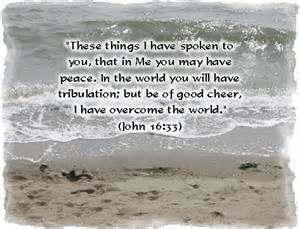 lead to peace. Not “world peace,” but our inner-peace. I’m not a psychiatrist or an addiction counselor, but it seems to me that a lack of inner-peace is at least partially, if not mostly, to blame for the majority of our bad habits, addictions, bad attitudes and other negative behaviors.
“For the mind set on the flesh is death, but the mind set on the Spirit is life and peace…” “So then we pursue the things which make for peace and the building up of one another.” (Romans 8:6 & 14:19)
I haven’t yet perfected this inner-peace thing, but I’ve come a long way over the last ten or fifteen years. I’ve discovered that seeking peace through doing things like reading the Bible, prayer, listening to sermons and having like-minded friends, including blog friends, will greatly increase our sense of peace. If our primary focus is on seeking peace—the Prince of peace, we make Christ our partner in overcoming addictions and bad habits and bad attitudes.
“Be anxious for nothing, but in everything by prayer and supplication with thanksgiving let your requests be made known to God. And the peace of God, which surpasses all comprehension, will guard your hearts and your minds in Christ Jesus.” (Philippians 4:6-7)
Even if you’ve already broken your resolutions, reset your priorities and start over again. Make seeking peace your number one goal and it will increase your joy and hope and give you the strength to conquer your “demons.”
“Now may the God of hope fill you with all joy and peace in believing, so that you will abound in hope by the power of the Holy Spirit.” (Romans 15:13)
 Unshakable Hope