Blog Archives
Opportunities In Trials
In the midst of a trial, the greatest temptation we face is to hunker down and wait for the storm to pass. I don’t believe this is ever God’s will.
We tend to view trials as a kind of imprisonment, thinking our life is on hold until the day we’re released from the grip of the life challenge. ALS has made me a virtual prisoner of my own body for the last 18 years. It has been a very cruel warden. But I look around me and see other people fighting illness or trying to overcome addictions, depression, abuse, debt and so many other cruel masters.
We must continue to hope and pray for freedom from whatever is trying to “hold us,” and we should do everything in our power to move toward that goal. But, in the meantime, we should look for opportunities for God to use us right where we are. This is what the Apostle Paul did, and I’m convinced it’s what God wants us to do.
It was from prison that Paul wrote the following: “Now I want you to know, brethren, that my circumstances have turned out for the greater progress of the gospel…” (Philippians 1:12)
We don’t usually associate the word “progress” with imprisonment or any kind of trial, but I believe that we should. If we wait until we “have it all together” before we try to help and give hope to others, many will go without help and die without hope.
Would I be a hypocrite telling people that God still heals when I’ve been held in the grip of a terminal disease for 18 years?
Let me answer that with another question: Was Paul a hypocrite for writing about freedom in Christ from the depths of what was likely a rat infested dungeon?
Paul was almost stoned to death by an angry mob and severely beaten other times. He also suffered from what he called “a thorn in his flesh” (many Bible scholars say this “thorn” was poor eye sight). Regardless, it’s unlikely that Paul was the handsome and strong man depicted in the Bible movies. After spending much of his time in prison and enduring countless beatings, he was likely pale and scarred, and probably in pain 24/7. Yet, God used this suffering servant to heal and give hope to others.
The Apostles faced the same trials, temptations and human frailties that we face. Yet, in the midst of trying to overcome their own trials and temptations and battling their own demons, they were feeding the poor, healing the sick and giving hope to others by spreading the good news.
People don’t care about how much we know until they know how much we care. Maybe we wouldn’t have truly learned to care apart from our suffering.
I hope you’re successful in keeping all of your New Year’s Resolutions, and 2015 is the best year you’ve had so far. But we cannot wait for all of our hopes to be fulfilled before we offer help and hope to others.

We overcome as we help others to overcome.
Good Intentions
With all the bad going on in the world, I was thinking about how much better it would be if we acted on most of our good intentions. Not only would the recipients of the good actions be better off, but I’m convinced that the doers of those that act on their good intentions would experience a greater sense of joy, hope and overall contentment.
“The road to hell is paved with good intentions.”
Jesus did say that the southbound road is really wide and the northbound road is extremely narrow (Matthew 7:13), but I don’t remember Him ever mentioning what the pavement was made of. I think legalistic religion would tell us that the road to hell is paved with evil actions (sin). The opposite extreme would tell us that this dark road is paved with legalistic bricks that have impossible-to-keep rules imprinted on them. Like most things, I believe that the truth is somewhere in between the extremes.
When I read the Bible, especially the New Testament, it becomes clear that God views our wrong actions (sins of commission) just as harshly as He does our failure to act on our good intentions (sins of omission). For example, in the Matthew’s gospel (25:31-46), Jesus paints a scary picture of what judgment day will be like:
“…for I was hungry, and you gave Me nothing to eat; I was thirsty, and you gave Me nothing to drink; I was a stranger, and you did not invite Me in; naked, and you did not clothe Me; sick, and in prison, and you did not visit Me.’ “Then they themselves also will answer, “Lord, when did we see You hungry, or thirsty, or a stranger, or naked, or sick, or in prison, and did not take care of You?’ “Then He will answer them, “Truly I say to you, to the extent that you did not do it to one of the least of these, you did not do it to Me.’
The frightening thing about the above passage is that these people who Jesus sent down the dark road, considered themselves to be Christians. If you read between the lines it becomes obvious that these people had developed a habit of not following the promptings of the Holy Spirit or their God-given conscience–they simply quit acting on their good intentions.

“For by grace you have been saved through faith; and that not of yourselves, it is the gift of God; not as a result of (good) works…” (Ephesians 2:8-9),
The Bible is clear that we are not saved by good deeds; we’re saved by grace through a commitment to follow Christ. But that commitment (if genuine) should bear fruit in the form of good works (James 2:18). It’s so easy for Christians to come to a place where we believe that we’re good because we’re not behaving badly. By definition this is self-righteousness. But we don’t overcome evil (in ourselves and in the world) just by not trying to do wrong; we overcome evil by doing good:
“Don’t let evil get the best of you, but conquer evil by doing good.” (Romans 12:21 NLT)
When going through a serious trial, it’s tempting to think that we should somehow be exempt from having to do good works; we might think that we should only be the recipients of the good works of others during these difficult times. Don’t believe this, it will only lead to despair. Our good works might seem insignificant (compared to others) when life’s challenges limit our physical, emotional and/or financial abilities, but, as Christians, we’ll never become exempt from doing good works. This poverty-stricken widow set the perfect example for those going through a trial:
“And He (Jesus) sat down opposite the treasury, and began observing how the people were putting money into the treasury; and many rich people were putting in large sums. A poor widow came and put in two small copper coins, which amount to a cent. Calling His disciples to Him, He said to them, “Truly I say to you, this poor widow put in more than all the contributors to the treasury; for they all put in out of their surplus, but she, out of her poverty, put in all she owned, all she had to live on.” (Mark 12:41-44)
Mary and I are so thankful for the family, friends and even people we didn’t know personally, that have helped us in so many ways throughout this almost 18 year battle with ALS (you know who you are). We don’t even want to think about how much worse this trial would have been had you not acted on your good intentions.
There are so many people in need, but maybe you feel, like I’ve felt at times, that you only have a penny’s worth of help, prayers, words of encouragement or even money to give. Think about the poor widow and just do what you can. I know that God will bless the person you help, and He’ll bless you for acting on your good intentions.
Thinking About Death
When I was a kid, I had a friend I’ll call “Bubba.” (There were no kids called Bubba where I grew up so I figure that’s a safe name to go with). Bubba was a high-maintenance friend that never called before coming over and always seemed to show up at my house when I was in the middle of doing something important, like watching Gilligan’s Island. He was hyper and never stopped jabbering on about stuff I wasn’t the least bit interested in. No matter how disinterested I acted, he would stay for hours and would even invite himself to dinner. To my immature and selfish mind, Bubba was annoying.
Before becoming a follower of Christ, I viewed thoughts and discussions about death much like I viewed Bubba knocking at my door – an unwelcome annoyance. After becoming a follower of Christ and coming to believe that my eternity in heaven was secured, I basically put the issue of death on a shelf thinking that one day, when I was old and gray, I would have to take it down, dust it off and deal with it. Even as a Christian, I still viewed death as “Bubba.” I never thought that welcoming death into my thoughts and prayers every day would be one of the best decisions of my life.
Old age, tragic accidents and horrible illnesses remind us that invincibility (in these bodies) is a  myth; we are deceiving ourselves. ALS jolted me out of that denial comfort zone and forced me to face death head on and it’s been the most life-transforming experience. I hope to convince others that thinking about death on a daily basis is good for us emotionally and spiritually. This is the exact opposite of what I believed before ALS invaded my life.
“…we had the sentence of death within ourselves so that we would not trust in ourselves, but in God who raises the dead…” (1 Corinthians 1:9)
A few months ago I read an article that listed the top 5 regrets of the dying. They are as follows:
I wish I’d had the courage to live a life true to myself, not the life others expected of me.
I wish I hadn’t worked so hard.
I wish I’d had the courage to express my feelings.
I wish I had stayed in touch with friends (Bubba, where are you?)
I wish that I had let myself be happier.
I suppose everyone’s list of deathbed regrets would vary from the above list, but in truth we’ll only have one regret on our deathbed: “I wish that I hadn’t lived in denial that this day would come.” All of our regrets grow out of denial about our death. One would think, as I once thought, that thinking about our death, putting ourselves on our deathbed, every day would be depressing, but I’ve discovered that the opposite is true.
 Like me, Ebenezer Scrooge wasn’t changed by reflecting on his past or even by discovering how others viewed him; he was only transformed when he came to terms with his own mortality. Obviously “A Christmas Carol” is not based on the Bible, but I believe Dickens got that part right.
“…that I may know Him and the power of His resurrection and the fellowship of His sufferings, being conformed to His death…forgetting what lies behind and reaching forward to what lies ahead…” (Philippians 3)
We rightly associate Easter with life, but Jesus’ whole mission was about defeating death. He had to face death before He could defeat it and so must we.
Viewing Ourselves in the Third-Person
I’ve heard people tell self-centered kids or those who otherwise feel entitled that “It’s not all about you.” We might not be that blunt, but I think all parents that are trying to raise selfless and grateful kids try to convey this message to them in one way or another.
Like many from my generation, my parents had more subtle ways of conveying this message; like when we didn’t eat all the food on our plate, they’d remind us that people in China were starving. Or when we asked for new shoes they would tell us about African children they saw in National Geographic that have never even worn shoes (I don’t know if my mom brought up the African women in National Geographic when my sisters asked for a new bra).
Regardless of how it’s said, the message is that we should be grateful for what we have and that the world doesn’t revolve around us; we have to view lives in the context of the whole world.
I thought about this recently while reading the Bible. I hadn’t really noticed it before, but I now believe this “It’s not (just) about us” message is Biblical. I think this is the reason that most of the New Testament, including all four Gospels, were written in the third-person.
For instance, Mathew wrote the following (about himself) as if he was a casual observer watching this unfold from fifty feet away: “As Jesus went on from there, He saw a man called Matthew, sitting in the tax collector’s booth; and He said to him, “Follow Me!” And he got up and followed Him.” (Matthew 9:9)
In his Gospel, John adds some mystery to his third-person account by referring to himself as “The disciple whom Jesus loved.” John never reveals that he’s the author of the fourth Gospel until the end of the last chapter.
But my favorite example of this third-party writing is the Apostle Paul. If you didn’t know his writing style and something about Biblical history, you might think he’s schizophrenic when you read the following: “I know a man in Christ who fourteen years ago…was caught up into Paradise and heard inexpressible words…” (2 Corinthians 12:2-4) It’s only when you read the whole chapter that you discover this mystery man that Paul was referring to was himself. It seems that Paul had what people today would call an “Out of Body experience.”
Paul wrote about everything that God did in and through him in the third-person. As he says in the first verse (of the same chapter) that “Boasting [in the first person] is foolish.” But he goes on to say that speaking (in the first-person) about his “weaknesses” (sins, temptations and overall human frailties) is good and necessary (in order to relate to others). A few verses later, Paul gives God’s answer to his prayer about one of his weaknesses. It’s one of my favorite verses, but it can only be fully understood if read in the context of this whole chapter:

By speaking and actually viewing themselves in the third-person, I believe that Paul and the other Apostles were following the example of Christ. Jesus referred to Himself (in the third-person) as “The Son of man” or “The Son of God” when speaking of His mission and when He performed miracle etc (“For the Son of Man has come to seek and to save that which was lost.” Luke 19:10), but He spoke in the first-person in regards to His human weaknesses; while hanging on the cross, He didn’t say “The Son of man is thirsty;” He said “I thirst” (John 19:28).
I thought about how different this was from many people today. We hear many people (think politicians) boasting about their accomplishments in the first-person and speaking about their human frailties in the third-person – as if some literal third-person was to blame.
Here are a few other things that I learned from this study:
- First-person thinking is natural; third-person thinking is intentional.
- Those who view their life in the third-person filter everything through the eyes of God and through the eyes of others; this is why John identified himself as the “The disciple whom Jesus loved.”
- To fulfill verses like the following, we must take a third-person view of ourselves “In everything, therefore, treat people the same way you want them to treat you…” (Matthew 7:12)
- Hypocrisy and self-righteousness are sins only committed by those who view themselves in the first-person.
- Legalism/religion is for those who view themselves in the first-person; grace comes to and through those who view themselves in the third-person.
- Those who view themselves in the third-person (through the eyes of God and others) have a much easier time ignoring their negative first-person thoughts.
I think Christians should follow the example of Jesus and His disciples – we should own our weaknesses and credit God for the good He does in and through us. To be a Christian is to be a servant of God and of others; It’s not (just) about us.
Why Me?
Over the years I’ve had ALS, I’ve become convinced that for a Christian to retain hope in the midst of a difficult trial, he or she must believe that God allowed the trial for a purpose; a purpose greater than what God would have been able to accomplish in and through that person apart from the trial.
“…even though now for a little while, if necessary, you have been distressed by various trials, so that the proof of your faith…may be found to result in praise and glory and honor at the revelation of Jesus Christ…” (1 Peter 1:6-7)
I think every Christian that goes through a difficult trial will eventually ask “Why me?”
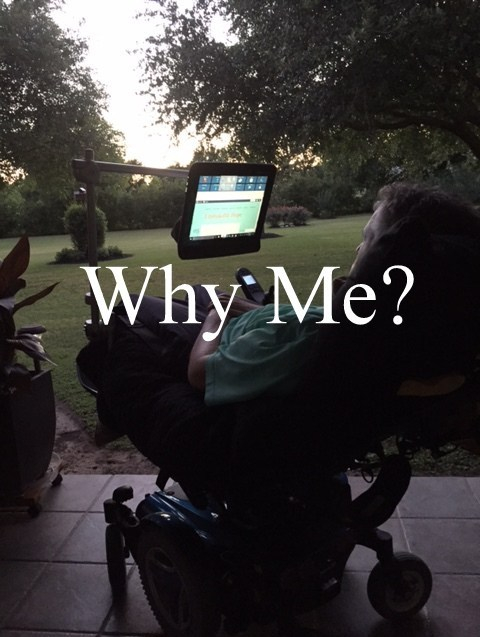
But, I’ve learned that our motive behind asking this seemingly simple question says a lot about how we view God – and also a lot about how we view ourselves.
The first man asks the question like this: “Why me; out of 7 billion people in the world, why did I get ALS (or whatever)?”
He’s really asking, “Why didn’t God put this horrible trial on one of the other 7 billion people?”
This man has a warped view of God and an exalted view of himself. He views his trial as pointless, and he thinks that he should somehow be exempt from the suffering of humanity.
I know what I said about this first man sounds harsh and judgmental, but I know this man well; in a spiritual and emotional sense, I wrestled with him for several months after being diagnosed with ALS.
Thankfully, with the help of God’s word, wise counsel from Christian friends and a well-timed conversation with our non-Christian next-door neighbors, I began to see that there might be a purpose, an eternal purpose, behind my trial. I defeated that “woe is me” man who was fighting to take control of my thoughts and emotions. (More about our next-door neighbors further down).
The second man asks the question like this: “Why me; what’s God’s purpose behind allowing this horrible trial?”
This man has the correct view of God and of his place in the world. As a Christian, this man knows that God wouldn’t have allowed this trial unless He had a greater purpose, a purpose that outweighs the suffering this man would have to endure (from his trial).
“And we know that God causes all things to work together for good to those who love God, to those who are called according to His purpose.” (Romans 8:28)
That verse can only be true if we have an eternal (“Big Picture”) view of our trial. God still heals and performs miracles, and I believe that we should always pray for that result. (Never give up on God doing miracles!)
Regardless of the outcome, God can bring about eternal good from every trial.
In a hundred years, the eternal good that comes from our trial will be the only thing that matters.
A difficult trial (usually) causes the Christian to focus more on the spiritual and the eternal things because, by comparison, the temporal and the material things begin to look more and more insignificant.
Back to our next-door neighbors: Mike and Lorraine were not followers of Christ when we met them. Of course, we did our Christian duty and invited them to church and tried to share the “Good news” with them. Even our girls (then 4 and 7) invited them to church, but all to no avail.
Mike and Lorraine later told us that they mocked us in private. I told them that I could relate because, before making a commitment to follow Christ, I mocked Christians too. Let’s be honest, making fun of Christians is so easy.
But, after I was diagnosed, Mike and Lorraine began to reexamine the faith that was sustaining our family through this trial. Lorraine told me:
“…When you were diagnosed with ALS I began to see a man who held no anger with the God that ‘allowed’ this to happen. Then you began to demonstrate trust in God’s plan. I saw your faith and I saw two little girls accept what God was doing in your lives and I began to wonder how such young children could love God unconditionally. I opened my heart first to the possibility that this might be a good thing for me as well. Then I finally got it and allowed my brain to accept the basic truth that God is only good, loving and faithful…”
Mike and Lorraine made a commitment to follow Christ and faithfully attend church and share their faith with others. (Now people probably make fun of them).
Would Mike and Lorraine have made a commitment to follow Christ if we had not gone through this trial? Obviously, only God knows the answer to questions like this. The only thing I know for sure is that this trial has strengthened my faith and has also given me more confidence in sharing that faith.
But, I admit that difficult trials can feel like you’re serving a prison sentence, especially when you have ALS and you’re imprisoned in your own body. However, the Apostle Paul wrote much of the New Testament while imprisoned. And, many of his fellow prisoners and the guards that observed Paul, became followers of Christ. Only Jesus can spread a message of hope through a prisoner – this is truly Unshakable Hope!
UPDATE: Sadly, Mike went through a long battle with cancer and is now with Christ in heaven. I am looking forward to seeing him again.
I hope I’ll see you there also.
“Now I want you to know, brethren, that my circumstances have turned out for the greater progress of the gospel, so that my imprisonment in the cause of Christ has become well known throughout the whole praetorian guard and to everyone else, and that most of the brethren, trusting in the Lord because of my imprisonment, have far more courage to speak the word of God without fear.” (Philippians 1:12-14)
(I have made changes to my blog, please let me know if you are having problems with it loading…)
 Unshakable Hope