Blog Archives
A Lesson We Learned From Our Honeymoon
Last Saturday (11/2) Mary and I celebrated our 28th wedding anniversary. Recently we were telling someone about our crazy honeymoon and I thought my blog friends might find interesting too.
I suppose to varying degrees all marriages have a mix of the good and the bad; memories you cherish and other times you wish you could forget. Our honeymoon was some of both also.
We bought our first home three months before our wedding and I moved in and began fixing it up. Buying a home and fixing it up turned out to be more expensive than we anticipated so our honeymoon plans had to be drastically scaled back.
I found a good deal for a week at a resort in a popular destination south of the border (for reasons that will become clear, I won’t name the location). The first four days of the trip were great; beautiful weather, great food and fun activities like snorkeling, parasailing and other fun things honeymooning couples do, but then came day five…
After a nice breakfast by the pool, we wandered into the hotel lobby and began browsing through the rack of activity brochures. Most of the local activities were either too expensive for our limited budget or uninteresting to us. But then we saw a brochure that interested both of us; a four hour guided horseback riding trip up a mountain trail along a beautiful flowing creek. The trip even included lunch at a picturesque mountain-top restaurant before turning around for the trip back down the mountain.
We handed the brochure to the concierge and asked him to book us. He made a call and informed us that activity was already sold-out for that day, but he knew of another guide that could take us up the mountain to the same restaurant shown in the brochure. Without asking questions, we told him to call and book us.
We became a little concerned when we arrived at the “stables” and saw that the location was a long way from the scenic mountain trail located behind the large stable featured in the brochure. We became more concerned when our “tour guide” turned out to be a skinny teenager that didn’t speak English. And we became even more concerned when we realized that we were the only people going on the trip with our young guide.
Pushing aside the cautionary voices in our heads, we mounted our docile horses. Our guide’s horse wasn’t as cooperative as our horses were; it moved from side-to-side and bucked as he was trying to get on.
After finally getting on his horse, our guide led us along the shoulder of the busy street, away from the entrance to the mountain trail. After waiting for a lull in the traffic and galloping across the street, we started up a dirt road. It quickly became clear to us that this was not going to be anything like the romantic horseback ride shown in the glossy brochure. The dirt road didn’t lead to a trail, it was the trail; a switchback road weaving by shack after shack. We had never seen such poverty.
About halfway up the mountain, we passed a dead and very bloated cow with a mangy dog chewing on its head (Mary hates when I tell that gruesome part). Our guide pointed to the cow as if his hand was a gun and shouted, “BANDITOS” and began nervously looking around and then picked up the pace.
After finally arriving at the restaurant, we saw a large group of people briskly crossing a footbridge; the footbridge that was strung across the stream we never saw on our way up the mountain. They were all American tourists like us; the horseback riding group we originally wanted to go with. It turns out that it was a good thing we didn’t join them because they were robbed at gunpoint by bandits just minutes before arriving at the restaurant. The robbers took all their jewelry and money; one older man had to be led by the hand because the thieves even stole their glasses.
Through a translator, our tour guide told us that the authorities were sending a truck to pick up the terrified people, but he felt that we’d be safe riding our horses back the same way we came up. When he saw the panicked look on our face, he shouted “Banditos go” and then pointed up at the mountains. The translator told us that our guide thought the bandits were probably hiding out in the mountains so he believed we’d be safe riding back down.
Nervously, but quickly we mounted our horses for the steep descent down the dirty switchback road. The ride up took about two hours, but we were going to make it down a lot faster than that, or so we thought.
We were making good time down the steep and winding road, but about a third of the way down, our tour guide was thrown violently from his temperamental horse. We heard a loud “SNAP” as he hit the ground and screamed out. He was one tough kid because he immediately stood up and began calmly examining his broken arm. It was bad, the bone was sticking out of his forearm and he was bleeding profusely. I quickly got down off of my horse to see if I could help him.
He began motioning for me to grab his hand and yank his arm to reset the broken bone. I didn’t think this was a good idea because the bone was clearly shattered and wasn’t going to simply go back into place. But he insisted so I planted my feet and began pulling as hard as I could on the poor guy’s arm. He screamed louder than I’ve ever heard someone scream and for an instant I wondered if I had misunderstood what he had motioned for me to do. But he insisted we give it another try and this time he screamed even louder. If the banditos were taking a siesta in their mountain hideaway, I was sure our screaming tour guide had woken them up.
For all we knew this kid was in shock and wasn’t thinking straight so I decided to take charge of the situation. We had to get him down off of the mountain and to a doctor right away. I wrapped his arm with a cloth and helped him get on the back of Mary’s horse. I pulled his unpredictable horse behind me.
After a long slow trek down the mountain we finally arrived back at the busy street. We tried repeatedly to flag down a car to take him to a doctor, but there were no Good Samaritans on the road that day. He finally motioned for us to bring him back to the stable, which we did. I insisted on giving him some cash to help pay his medical expenses, but he refused to take my money.
We were hot, exhausted and extremely thirsty when we finally arrived back to our hotel room. Because the cost was so outrageous, we had agreed not to eat or drink anything from the mini fridge in our room, but we decided to make this one exception. I quickly grabbed a bottle of Sprite and we took several large gulps. When the bottle was almost gone, Mary stopped me as I went to take another drink – the bottle was full of tiny bugs, hundreds of them. Obviously the bottle washing machine was broken the day this bottle was filled.
We decided to put our crazy morning and afternoon behind us and make the most of that night. We made reservations at a casual restaurant that the concierge, the same concierge, had recommended.
After a shower and a short nap, we were surprisingly rested and refreshed when the cab picked us up to take us to the restaurant. The drive up to the oceanfront restaurant was beautiful with the tree-lined mountains on one side and the sun setting over the ocean on the other side. Finally something that qualified as romantic on our honeymoon, but it was short-lived…
 We forgot to bring Mary’s good camera on the trip, but even with the cheap camera we picked up at a drug store, you can see from the picture that the view from the restaurant was spectacular. The food was as good as the view, but taste and appearances can be deceptive…
By the time Mary and I arrived at our hotel room, we were violently ill; it was obviously a severe case of food poisoning. From then on out, the only contact we had with each other was brushing by one another as we exchanged places in the bathroom. It was horrible; we were like Protestants visiting a Catholic Church – we didn’t know whether to kneel or sit.
I was somewhat better the following morning, but Mary was getting worse. I booked us on the next flight home and took Mary straight to the hospital. After a 24 hours in the hospital on an IV and antibiotics, she was finally well enough to go home.
Our honeymoon turned out to be a kind of a metaphor for the years that followed; there have been good times, but also some difficult mountain climbs.
Life is so unpredictable; it’s like a switchback road, you never know what will greet you around the next turn. But, if Christ is our guide, He’ll give us the grace we need to deal with any and everything that awaits us.
“Who will separate us from the love of Christ? Will tribulation, or distress, or persecution, or famine, or nakedness, or peril, or sword? …in all these things we overwhelmingly conquer through Him who loved us.” (Romans 8:35-37)
The Greatest Christian I Know
Who is the greatest Christian you know?
I will give my answer to that question at the end of this post.
I realize that questions such as this could be classified by some as judging others. But the Bible does tell us to “test ourselves” (2 Corinthians 13:5) and to test spiritual claims and people (1 John 4:1 & Revelation 2:2). The Bible also gives us attributes to look for when conducting these examinations of ourselves and others.
Here are some of the attributes (of great Christians) that I’ve found in the Bible:
- Compassionate, Kind, Humble, Gentle, Patient, Bearing the burdens of others and Forgiving (Colossians 3:12-13)
- Encouraging and Building-up others (1 Thessalonians 5:11).
- A reader and a “doer” of God’s word (James 1:22).
- Hospitable, Sensible, Just, Devout and Self-controlled (Titus 1:8).
- Loving, Joyful, Peaceful, Faithful (Galatians 5:22)
- Prayerful, Thankful (to God and others) and Hopeful (Colossians 1:3-5).
If you tested yourself by the above criteria and concluded that you deserve an A+ on every one these virtues, you’re either delusional or off-the-charts self-righteous. Everyone, even the person I chose as “The Greatest Christian I Know,” struggle with some of these.
But, according to Jesus, a truly great Christian possesses one quality that sets them apart; “But the greatest among you shall be your servant.” (Matthew 23:11)
![“True greatness, true leadership, is achieved not by reducing [people] to one’s service, but by giving up oneself in selfless service to them.” Oswald Chambers](https://unshakablehope.com/wp-content/uploads/2013/10/servant.jpg)
“True greatness, true leadership, is achieved not by reducing [people] to one’s service, but by giving up oneself in selfless service to them.” Oswald Chambers
I think of people like my sister and her husband who care for their 18 year-old severely Autistic son. People like my mother-in-law who took care of her ill husband until he recently passed away. And even paid caregivers, like the woman that helps Mary take care of me, qualify as “Great” in my book.
But the Greatest all-around Christian I know is Mary, my wife and best friend of 28 years. Since being diagnosed with ALS years-ago, she’s also been my full-time caregiver. She is the best example I know of a truly selfless servant.
And, no, I didn’t just choose her as the greatest Christian out of fear that she’d stop feeding and clothing me.
“…whoever wishes to become great among you shall be your servant, and whoever wishes to be first among you shall be your slave; just as the Son of Man did not come to be served, but to serve…” (Matthew 20:26-28)
When God Intervenes
Before having ALS, I would have thought that it would be the big effects of this disease that cause the most frustration—things like not being able to walk and talk. But it’s losing your ability to do simple things, things you once did with little or no effort, that cause the most frustration. Imagine having an itch you can’t scratch or having a mosquito biting the back of your hand and all you can do is sit and watch as it becomes fat with your blood, leaving another itch you can’t scratch.
Being confined to a wheelchair and not being able to speak would be more bearable if I was able to read books, but even that once-simple pleasure is now impossible. I was especially frustrated with my inability to hold a book and turn its pages when I received a copy of a book titled “When God Intervenes” in the mail two weeks ago. This book was written by a friend named Dabney Hedegard, and I had been looking forward to reading it since she told me about it several months ago. Fortunately, Mary had also been looking forward to reading it so she volunteered to read it to me.
The reason I used the example of not being able to scratch an itch is because the book begins with Dabney visiting doctor after doctor and having test after test to determine what was causing the constant itching all over her body. (I began to itch just thinking about it). Every doctor said or inferred that Dabney was a Hypochondriac. She would soon prove all of those doctors wrong, the hard way!

Dabney endured the constant itching and the sleeplessness that came along with it for five tortuous months. Then, as Dabney retells it in the book, something happened that, by comparison, made her constant itching and the exhaustion seem like a minor annoyance: “I propped my feet on the couch and scratched across my belly, trying to chase away the tickles. In the silence of my apartment, I tried to nap. But my midmorning indigestion had progressed into a heavy weight against my lungs. The roll of fruit-flavored TUMS refused to calm the pressure. Then it happened. One gasp followed by strained constriction— as if someone had popped my lung. I banged my fist to my chest to pound out some relief. Nothing. Sitting up straighter, straighter, I struggled to suck in air. “I c-can’t breathe…”
Dabney’s husband, Jason, rushed her to the ER where doctors discovered a football-sized tumor in her chest; it was Hodgkin’s Lymphoma. In some cases, for some unknown reason, this type of cancer can cause the itching that she was experiencing. To complicate matters and add to the drama of this miraculous story, Dabney was six weeks pregnant with their first child.
This was the start of what would become a ten year trial; a decade of Jason and Dabney having their faith repeatedly tested and God intervening time after time with miracle after miracle. A ten year trial that included four near-death experiences and twice doctors telling Jason, “She’ll never make it through the night.”
“…we also exult in our tribulations, knowing that tribulation brings about perseverance; and perseverance, proven character; and proven character, hope; and hope does not disappoint…” (Romans 5:3-5)
The above passage came to my mind when I read what Dabney said this book was about: “This story is about an ordinary girl in search of hope.” Mary and I saw that passage unfold in Dabney and Jason while reading “When God Intervenes.” This “ordinary girl” finds the hope that she was in search of and is now giving that hope to others through her public speaking engagements, her blog and now through this inspiring new book.
And no, I’m not recommending When God Intervenes just because Dabney flattered me by including a quote from one of my blog posts in the book. I’m recommending this book because reading it encouraged us and increased our faith and hope and I know it will do so for you also.
To order When God Intervenes, click here.
Why Me?
Over the years I’ve had ALS, I’ve become convinced that for a Christian to retain hope in the midst of a difficult trial, he or she must believe that God allowed the trial for a purpose; a purpose greater than what God would have been able to accomplish in and through that person apart from the trial.
“…even though now for a little while, if necessary, you have been distressed by various trials, so that the proof of your faith…may be found to result in praise and glory and honor at the revelation of Jesus Christ…” (1 Peter 1:6-7)
I think every Christian that goes through a difficult trial will eventually ask “Why me?”
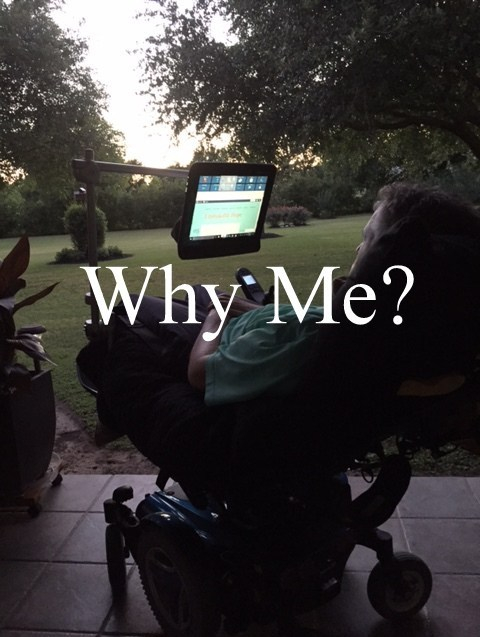
But, I’ve learned that our motive behind asking this seemingly simple question says a lot about how we view God – and also a lot about how we view ourselves.
The first man asks the question like this: “Why me; out of 7 billion people in the world, why did I get ALS (or whatever)?”
He’s really asking, “Why didn’t God put this horrible trial on one of the other 7 billion people?”
This man has a warped view of God and an exalted view of himself. He views his trial as pointless, and he thinks that he should somehow be exempt from the suffering of humanity.
I know what I said about this first man sounds harsh and judgmental, but I know this man well; in a spiritual and emotional sense, I wrestled with him for several months after being diagnosed with ALS.
Thankfully, with the help of God’s word, wise counsel from Christian friends and a well-timed conversation with our non-Christian next-door neighbors, I began to see that there might be a purpose, an eternal purpose, behind my trial. I defeated that “woe is me” man who was fighting to take control of my thoughts and emotions. (More about our next-door neighbors further down).
The second man asks the question like this: “Why me; what’s God’s purpose behind allowing this horrible trial?”
This man has the correct view of God and of his place in the world. As a Christian, this man knows that God wouldn’t have allowed this trial unless He had a greater purpose, a purpose that outweighs the suffering this man would have to endure (from his trial).
“And we know that God causes all things to work together for good to those who love God, to those who are called according to His purpose.” (Romans 8:28)
That verse can only be true if we have an eternal (“Big Picture”) view of our trial. God still heals and performs miracles, and I believe that we should always pray for that result. (Never give up on God doing miracles!)
Regardless of the outcome, God can bring about eternal good from every trial.
In a hundred years, the eternal good that comes from our trial will be the only thing that matters.
A difficult trial (usually) causes the Christian to focus more on the spiritual and the eternal things because, by comparison, the temporal and the material things begin to look more and more insignificant.
Back to our next-door neighbors: Mike and Lorraine were not followers of Christ when we met them. Of course, we did our Christian duty and invited them to church and tried to share the “Good news” with them. Even our girls (then 4 and 7) invited them to church, but all to no avail.
Mike and Lorraine later told us that they mocked us in private. I told them that I could relate because, before making a commitment to follow Christ, I mocked Christians too. Let’s be honest, making fun of Christians is so easy.
But, after I was diagnosed, Mike and Lorraine began to reexamine the faith that was sustaining our family through this trial. Lorraine told me:
“…When you were diagnosed with ALS I began to see a man who held no anger with the God that ‘allowed’ this to happen. Then you began to demonstrate trust in God’s plan. I saw your faith and I saw two little girls accept what God was doing in your lives and I began to wonder how such young children could love God unconditionally. I opened my heart first to the possibility that this might be a good thing for me as well. Then I finally got it and allowed my brain to accept the basic truth that God is only good, loving and faithful…”
Mike and Lorraine made a commitment to follow Christ and faithfully attend church and share their faith with others. (Now people probably make fun of them).
Would Mike and Lorraine have made a commitment to follow Christ if we had not gone through this trial? Obviously, only God knows the answer to questions like this. The only thing I know for sure is that this trial has strengthened my faith and has also given me more confidence in sharing that faith.
But, I admit that difficult trials can feel like you’re serving a prison sentence, especially when you have ALS and you’re imprisoned in your own body. However, the Apostle Paul wrote much of the New Testament while imprisoned. And, many of his fellow prisoners and the guards that observed Paul, became followers of Christ. Only Jesus can spread a message of hope through a prisoner – this is truly Unshakable Hope!
UPDATE: Sadly, Mike went through a long battle with cancer and is now with Christ in heaven. I am looking forward to seeing him again.
I hope I’ll see you there also.
“Now I want you to know, brethren, that my circumstances have turned out for the greater progress of the gospel, so that my imprisonment in the cause of Christ has become well known throughout the whole praetorian guard and to everyone else, and that most of the brethren, trusting in the Lord because of my imprisonment, have far more courage to speak the word of God without fear.” (Philippians 1:12-14)
(I have made changes to my blog, please let me know if you are having problems with it loading…)
Overcoming Regrets
Do you ever feel like your regrets are haunting you like ghosts from your past?
I used to allow regrets over things I’ve said or wished I had said and things I’ve done or wish I had done, to steal my joy, peace and hope. I became so aggravated with these condemning “ghosts” of regret that I finally decided to figure out how to defeat them. The following “battle-plan” (for conquering regrets) has helped me and I hope it might help others dealing with this problem too.
Defining this enemy
Even though I knew what the word regret meant, I began by looking up the definition, which, according to Webster’s Dictionary, is: “sorrow aroused by circumstances beyond one’s control or power to repair: an expression of distressing emotion (as sorrow)”
I also noticed that repent is one of the synonyms for the word regret. I suppose this makes sense in one way; it’s the same thing to feel regretful and repentant (over something we’ve said or done). But, from the Christian point of view, there’s a contradiction between the definition of regret and the synonym of repent. The definition says that regret is “beyond one’s control or power to repair,” but the Bible repeatedly tells us that repentance is the “power to repair” (regrets, guilt and shame). I just had this thought: If regretting and repenting were synonymous, repenting of something we regretted would be redundant.
The Apostle Paul wrote; “…the sorrow that is according to the will of God produces a repentance without regret, leading to salvation, but the sorrow of the world (by Webster’s definition) produces death.” (spiritual, emotional and even physical death) (2 Corinthians 7:10)
Here’s an example of what Paul meant: Judas regretted betraying Jesus (Matthew 27:3), but he didn’t repent of his betrayal and his failure to repent “produced death.” Whereas Peter regretted denying Jesus (Matthew 26:75), but he repented and moved on.
Defeating the enemy
I know that Peter, Paul and all Christians regret mistakes and past wrongdoing, but if we truly believe that “If we confess our sins, He is faithful and righteous to forgive us our sins and to cleanse us from all unrighteousness” (1 John 1:9), we’ll get to the place where our regrets no longer have the power to control our emotions; we’ll begin to put them into perspective by understanding how God is making good result from our failures.
As I’m sure you’ve figured out by now, I’ve come to the conclusion that these feelings of oppressive regret and condemnation are not from God. I think that many of us won’t release these feelings of regret because we wrongly believe that to feel regret is to be repentant. But the Bible tells us that the Christian life is a spiritually and emotionally “abundant life;” a life of joy, peace and hope. These uplifting things that sustain us through even the most difficult trials cannot possibly coexist with feelings of guilt, regret and despair.
I believe the first step to putting your regrets behind you, where they belong, is to quit allowing them to attack your mind as a force – divide and conquer them. When regrets come to your mind, begin to categorize them. For instance, if the regret is over something that’s in your power to resolve; like apologizing to someone or paying back money you’ve borrowed etc, take the actions needed to resolve that regret. This category might be what the Bible calls “the conviction of the Holy Spirit,” which prompts us to act according to God’s will – it works with our conscience. It’s vital to resolve this category in order to have a good (guilt-free) relationship with God – “…if our conscience is clear, we can come to God with bold confidence.” (1 John 3:21 NLT)
Another category, which was a big “ghost” for me, was regrets I harbored regarding things I said or wished I had said to loved-ones that have passed away. I am no longer haunted by this ghost; he faded away when I realized that I don’t want my memory to evoke feelings of guilt and regret (for my family and friends) when I’m gone, and I know those that I’ve lost didn’t want me carrying around that burden either.
There are many other categories of regret; parenting and relationship mistakes, bad investment mistakes, times we’ve sinned against God and hurt others and so on, but none of these categories controls my emotions any longer, and I believe it’s God’s will for every Christian to overcome oppressive feelings of guilt and regret.
You may wonder, as I did, what the source of these feelings of regret and false-guilt is if it’s not from God, as the Bible says – “…there is now no condemnation for those who are in Christ Jesus.” (Romans 8:1)
That means the source must be our carnal nature (“self-condemnation”) and/or an outside dark spiritual force. I believe it’s probably some of both. The Bible tells believers that our old nature is at war with our new nature: “…the flesh sets its desire against the Spirit, and the Spirit against the flesh…” (Galatians 5:17). The Bible also says that Satan is our “accuser” (Revelation 12:10) and that he attempts to negatively influence our mind, will and emotions through people and in other ways.
But regardless of what the source is, it’s clear that the last thing any negative source wants is for regretful thoughts to provoke thanks-giving to God, so this is the most powerful weapon against these things. Form a habit of thanking God for forgiving you (of the things you regret) every time a regret comes to mind. I promise you that the power these regrets have to cause sadness and feelings of shame and condemnation will begin to diminish and you will start to see your past in its proper context – God’s context.
The Apostle Paul is an excellent example of putting regrets in the proper context. He repeatedly referred back to his regrets of persecuting, imprisoning and even participating in the killing of Christians; he even said that he wasn’t even “fit to be called an apostle…” (1 Corinthians 15:9). But then he added the following words that I’ve adopted and hope every follower of Christ will apply to themselves – “But by the grace of God I am what I am, and His grace toward me did not prove vain…” (1 Corinthians 15:10)
If we’re allowing our regrets to affect our joy, peace and hope, His grace is proving to be vain to us; we’re essentially telling Jesus that His suffering and death wasn’t enough to take away our former sins and mistakes. It’s a new year; it’s time to let your regrets go!
“…if anyone is in Christ, he is a new creature; the old things passed away; behold, new things have come.” (2 Corinthians 5:17)
“… one thing I do: forgetting what lies behind and reaching forward to what lies ahead, I press on toward the goal for the prize of the upward call of God in Christ Jesus.” (Philippians 3:13-14)
“You can’t go back and change the beginning,
but you can start where you are and change the ending.” C.S. Lewis
 Unshakable Hope