Blog Archives
Uncomfortable Truth
It seems that America is obsessed with comfort these days. Have you noticed all the mattress commercials? They all claim that their brand is the most comfortable and tell us that we need to replace our mattress every eight years to maintain that optimum comfort. One mattress store will even finance your mattress for eight years. (I don’t care how comfortable the mattress is, if you finance it, you’ll probably be up half the night worrying about making your mattress payment).
Don’t get me wrong, I’m probably more obsessed with finding physical comfort than most people. One of the most difficult things about being paralyzed by ALS is trying to get comfortable because my body is literally dead weight. There’s no turning over or even turning my head in order to get more comfortable when I go to bed. I recently got a new mattress, the one that I see the most commercials for, and it’s every bit as comfortable as the manufacturer claims, and I really do sleep better. (Don’t tell the mattress people, but the mattress I replaced was twelve years old).
So I really appreciate physical comfort, but…
It also seems that much of the Western world is seeking a more comfortable (politically correct…) form of Christianity. Even if I wanted to do so, I’ve concluded that I’m just not clever enough to make Jesus and the New Testament into something more “comfortable.” Even writing this post is out of my comfort zone.
Like a lot of non-Christians, before making a commitment to follow Christ, I viewed Christians as narrow-minded, judgmental and hypocritical. My cynicism about Christians (churchgoers) was so deep that, even after committing to follow Christ, I wanted nothing to do with church or churchgoers (“organized religion“). For about five months, I read the Bible for an hour or two every night. With no preachers or churchgoers to influence me, I learned to just take the Bible at face value – I became convinced that it is God’s word.

I eventually accepted an invitation to go to church and discovered that most Christians are not narrow-minded, judgmental or hypocritical. I also came to realize that non-Christians can be all of the things that I was accusing Christians of being.
Jesus said to him, “I am the way, and the truth, and the life; no one comes to the Father but through Me.” (John 14:6)
How does one make words like Jesus’ above quote more “comfortable” for the Jew, the Muslim, the Buddhist, the Hindu or for anyone else of a different belief system? As I said, I’m not that clever. Even if we “speak the truth in love,” as the Bible instructs us to do, verses like this and so many others can be taken as fightin’ words by many people.
Jesus is not a unifier; He is the most divisive figure in all of history. Trying to make His words more “comfortable” will only serve to strip them of their life-transforming and hope-giving power. Besides that, people deserve honesty not comfortable condescension.
Other than His most devout followers, the only people that Jesus succeeded in unifying was/is His political and religious enemies: “Herod and Pilate became friends with one another that very day (the day they crucified Jesus); for before they had been enemies with each other.” (Luke 23:12).

CS Lewis
What would a “comfortable” (acceptable to all religious and political groups) “Christianity” look like? China has already given us the answer. The following are just some of the rules the Chinese state-approved “churches” have to follow:
• The Communist Party has the final decision on who can preach and what can be preached.
• Preaching about the resurrection and the second coming of Jesus is forbidden.
• Gathering to worship outside approved churches and official “meeting points” is forbidden.
• Evangelizing or giving out tracts is forbidden.
• Importing Bibles is forbidden, even if they are given away for free.
• Printing Bibles is forbidden, even if they are given away for free.
• Government officials cannot be Christian.
• Teachers cannot be Christian.
• Soldiers cannot be Christian.
• Police officers cannot be Christian.
• Children and teenagers cannot be Christian.
Obviously the above is not Christianity, but sadly there are many churches in North America and Western Europe that could relocate to the middle of Beijing without having to change what they preach.
China is officially an atheist country, including the education system. But the truth is that China will soon have more Christians than any other nation on earth. The majority of these Chinese Christians meet secretly in house churches that teach the true message of the Gospel. They risk beatings, imprisonment, losing their homes, jobs and even their lives. Like the early Christians and so many oppressed believers around the world today, they’ve chosen the uncomfortable road.

Opendoors.org
With the increasing pressure from governments, the education system, the media and even some Christian denominations to make Christianity more politically correct and comfortable for all people, which road will you choose?
What Kind of Tree Are You?
Some might be disappointed, but this is not one of those quizzes like I see posted on Facebook. (There actually is one of those quizzes with this same title, but I didn’t take it because I was afraid that the results would show that I was Charlie Brown’s Christmas Tree).
 Ten or twelve years ago, let’s just say eleven, Mary and I were shopping at Home Depot. After finishing our shopping in the store, we wandered out to the garden department to look for some small trees. It was November, and most of the plants were marked down because they were making room for Christmas trees.
Mary got hung up looking at wreathes and other boring items, so I cruised my wheelchair over to go look at trees. As it turned out, there were not many trees left, and I didn’t see anything I was interested in. Just when I was about to return to Mary and tell her not to bother coming over there, I spotted a tiny tree that was hidden behind two huge trees. With the footrest of my wheelchair, I pushed one of the large tree pots aside so I could get a better look at the little tree.
The tag on the tree identified it as a Bald Cypress, but it just looked like a two foot high vertical stick that sprouted a few tiny horizontal twigs. Other than a few yellowed leaves, there was no foliage on it at all; it was pitiful. But, it was marked down to only five dollars.
About that time, Mary walked up and assumed that I was looking at one of the large trees in front. Before I even noticed that she was there, I heard her voice, “That won’t fit in the van.”
ALS had already robbed me of my ability to speak, so I kicked the pot of the scrubby tree in back so she would know what I was looking at. After bending to see beneath the foliage of the trees in front, she rolled her eyes and began to walk away, thinking that I was joking.
When she finally figured out that I was serious about buying the tree, she dug it out and put it in her shopping cart. Couples (hopefully) learn to pick their battles after years of marriage and I’m sure she figured that a five dollar tree wasn’t a battle worth fighting. But I’m also sure that she felt vindicated when the cashier joined her in laughing at the tree.
After getting home, we looked for a place to plant the pathetic little tree. We finally agreed to plant it between the shed and our neighbor’s fence (I don’t remember, but Mary probably chose that spot because it was kind of hidden). After planting it, I had her place rocks around it so the men that mow our yard didn’t run over it thinking it was a weed.
“He (Jesus) presented another parable to them, saying, “The kingdom of heaven (the Christian life) is like a mustard seed, which a man took and sowed in his field; and this is smaller than all other seeds, but when it is full grown, it is larger than the garden plants and becomes a tree…” (Matthew 13:31-32)
I didn’t have the ability to voice it at the time, but I was in total agreement with Mary and the cashier that the tree was pathetic. But I wasn’t focusing on the tree itself, I was looking at the picture of a mature Bald Cypress on the plastic tag that was attached to the stick-like trunk of the tree.
As Jesus said in the parable above, the walk of faith begins so small; like my tree, the beginning of our spiritual life is often pathetic. There will be storms that batter us as we grow, but if we remain focused on Christ and on the picture of what God designed us to be, we will conform to that image – just like my tree conformed to what I envisioned it to be:

“Do not despise these small beginnings, for the LORD rejoices to see the work begin…” (Zechariah 4:10)
A Good Quality of Life
I’ve been thinking a lot about quality of life issues lately. More specifically, I’ve been trying to figure out why some people that (in the natural) possess virtually everything we think would make for a good quality of life, yet they’re miserable. Conversely, many others have almost none of the ingredients that we think must be in the mix for a good quality of life, but they seem perfectly content.
I think about this issue more and more as life with ALS becomes an even greater challenge. If ALS takes its natural course, the victim will die of respiratory failure. The muscles needed to breathe become weaker and weaker to the point where you just can’t breathe anymore. Oftentimes the flu or pneumonia are just too much for those with advanced ALS and can speed up this respiratory failure.
I had a severe case of the flu in February, and last month, I spent five days in the hospital with pneumonia. Both times I thought it might be the end of my journey in this life. I was definitely not happy with my quality of life when it took all the strength I had (which isn’t much) just to take a breath.
In a post from a few years ago, I said that I would rather die than live with a horrible disease like ALS. At the time I made that statement (about a year before being diagnosed with this horrible disease), I was healthy and had most of the things that people associate with a good quality of life.
I know that some people look at me and think that they’d rather be dead than live like this. I get it. But, as a Christian, I now believe that I was proud and kind of shallow when I made that statement so many years ago.
It’s so easy for Christians to quote well-known Bible verses when we’re not facing difficult challenges, but these same verses become real and so profound when life gets hard. For example, quoting Philippians 4:13 (“I can do all things through Him who strengthens me“), is easy when you’re strong, but it takes on a whole new meaning when you don’t even have enough strength to open your Bible and turn to it.
Does Philippians 4:13 still apply to people like me? YES!
If we put that verse in its proper context by reading the two verses that precede it:
“…I have learned to be content in whatever circumstances I am. I know how to get along with humble means, and I also know how to live in prosperity; in any and every circumstance I have learned the secret of being filled and going hungry, both of having abundance and suffering need. I can do all things through Him who strengthens me.”
In this passage, Paul is saying that the strength Christ gives us is to be “content (with our quality of life) in whatever circumstances” that we find ourselves in. I’m convinced that it’s this strength or lack thereof that determines how we view our quality of life when going through a difficult trial.
There was a time that I really didn’t like reading verses about God making us content in difficult circumstances. Contentment means you are happy, satisfied, comfortable and other words that sounded more like a Hawaiian vacation than trying to cope with a difficult trial like ALS. I basically viewed contentment as the enemy of hope (for a better quality of life). But I’ve since learned that contentment (in the Biblical sense) is not the enemy of hope; they’re partners.
“…hope that is seen is not hope; for who hopes for what he already sees? But if we hope for what we do not see, with perseverance we wait eagerly for it.” (Romans 8:24-25)
God-given contentment gives us the perseverance we need to keep on hoping for a better quality of life. Christ gives us contentment for today and hope for a better tomorrow; if we are not content today, we won’t have hope for tomorrow.
One day “tomorrow” will be eternity; the day that contentment no longer has need of hope or faith. It will be so much better than a Hawaiian vacation.
I’ve learned that the first and most important step to improving your quality of life is to do everything possible to improve the quality of life for others.
“Give, and it will be given to you…” (Luke 6:38)
God Has Friends In Low Places
The other day I was sitting out in the backyard listening to an audio book and getting a much-needed dose of vitamin D. Two Mockingbirds were darting back and forth just feet in front of me and were making so much noise that it was becoming difficult to hear my audio book. I knew that they had a nearby nest and were only trying to protect their young from a potential threat (apparently Mockingbirds don’t understand that paralyzed people in a wheelchair don’t pose a threat).
Then I saw two beautiful Bluebirds sitting in a nearby live oak tree just minding their
own business. Like me, they seemed to be doing their best to ignore the noise and the antics of the paranoid Mockingbirds. Every five minutes or so, one of the Bluebirds would fly over and land on the roof of a dilapidated birdhouse that Mary’s been meaning to replace. After observing this for almost an hour, Mary came outside and told me that the Bluebirds have a nest in that old birdhouse.
 I was thinking that there must be a serious birdhouse shortage in our area for these beautiful Bluebirds to have chosen this run-down dwelling to build a nest. Then I remembered that Jesus was born in a smelly stable. Maybe there was a pair of Bluebirds nesting in that stable too.
I had somewhat of a revelation about the beautiful and holy taking up residence in dwellings that are far beneath them. It’s the one thing that distinguishes genuine Christianity from every other belief-system that can be named; the Holy Spirit (literally) resides in the followers of Christ.
“Or do you not know that your body is a temple of the Holy Spirit who is in you, whom you have from God, and that you are not your own?” (1 Corinthians 6:19)
It’s not a coincidence that Jesus was born in a place that most homeless people would have avoided. But, even if Jesus would have been born in the greatest palace on earth, it would have been far beneath Him. It’s as if God chose the lowest of places to emphasize this.
It’s also not a coincidence that we see this same pattern with the birth of the Church (Acts chapter 2). The Church began with the Holy Spirit indwelling a bunch of very ordinary men and women that were gathered together in a room. From a Holy God’s perspective, that “upper room” was a very “stable-like” scene. But even if the Holy Spirit began His work in the hearts of the holiest of men on earth, it would have been far beneath Him.
The disciples were grief-stricken after Jesus explained to them that He would have to die. He comforted them with the following words:
“I will ask the Father, and He will give you another Helper, that He may be with you forever; that is the Spirit of truth, whom the world cannot receive, because it does not see Him or know Him, but you know Him because He abides with you and will be in you.” (John 1:16-17)
Later Jesus told the disciples that all of them would abandon Him. Peter stated emphatically that he would die with Jesus before denying Him. We now know that, out of fear of being arrested, Peter ended up denying Jesus three times within hours of making that vow.
But after being indwelt with the Holy Spirit (the “helper” and “Spirit of truth”), this same Peter stood before thousands of the very people he once cowered before and boldly declared that Jesus is “both Lord and Messiah.”
This man that was so afraid of being associated with Jesus on the night that He was arrested that he denied even knowing Him, years later would ask to be crucified upside down because he didn’t feel worthy to die in the same manner as his “Lord and Messiah.”
Biblical knowledge is so important, but theological knowledge alone cannot transform a person the way Peter and the other disciples were transformed: only the Holy Spirit can do that. And this kind of radical transformation is the true and lasting message of the Easter story.
“But if the Spirit of Him who raised Jesus from the dead dwells in you, He who raised Christ Jesus from the dead will also give life to your mortal bodies through His Spirit who dwells in you.” (Romans 8:11)
Trials Can Make Us Stronger
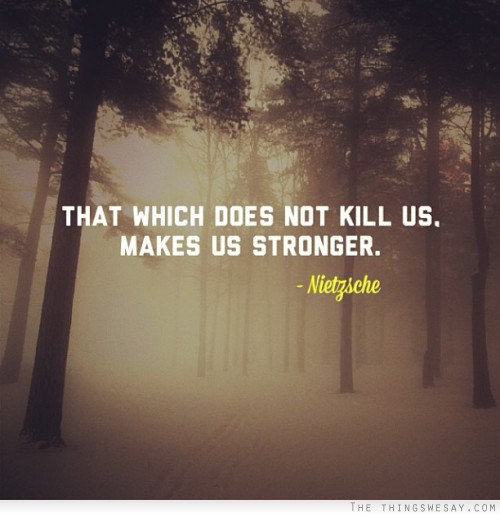
I never thought that I would be using a quote from the atheist philosopher Friedrich Nietzsche in one of my blog posts, but…
This quote came to my mind the other day and I began thinking about it and the man that wrote it. I spent most of February sick or recovering from the flu and other health issues. What little strength and energy I had before the illness has finally returned in the last few days. I’m definitely not physically stronger than I was before the illness. But I do feel spiritually stronger than I was before my battle with “that which did not kill me.”
As an atheist, Nietzsche only believed in the physical world so I can only assume that this quote was referring to trials making people (himself) physically and/or emotionally stronger. I wonder if he still believed those words while lying helpless and suffering from the effects of Syphilis for the last eleven years of his life.
As someone who has relied on caregivers for even longer than Nietzsche had to (ALS, not Syphilis), I empathize with the helpless, the suffering and their caregivers. But I feel great sympathy for those that do not place their hope and strength in Christ, regardless of the state of their health. I feel sympathy because, like Nietzsche, the “strength” and “hope” that they derive from physical/temporal pleasures do not provide genuine and lasting joy or peace. As King Solomon concluded, it’s “all vanity.”
I am convinced that the following is the only strength that can be gained from “that which does not kill us”:
“…we do not lose heart, but though our outer man is decaying, yet our inner man is being renewed (strengthened) day by day. For momentary, light affliction is producing for us an eternal weight of glory far beyond all comparison, while we look not at the things which are seen, but at the things which are not seen; for the things which are seen are temporal, but the things which are not seen are eternal.” (2 Corinthians 4:16-18)
There are so many great earthly pleasures and blessings, but not even the best of them deserve our hope. If Christ is our hope, the pleasures we enjoy on earth will be so much more enjoyable because we’ll have our priorities in order and we won’t have to rely on the physical/temporal things for happiness.

“For in hope we have been saved, but hope that is seen is not hope; for who hopes for what he already sees? But if we hope for what we do not see, with perseverance we wait eagerly for it.” (Romans 8:24-25)
 Unshakable Hope