Blog Archives
The Will To Live
I almost made it through a whole year without being hospitalized or having any additional health problems. Almost. Then, with just a few days left in 2016, I caught a cold. The “common cold” is not much more than an annoyance for otherwise healthy people, but for someone like me with weakened breathing muscles and only 30% of my lungs functioning, the common cold is much more than an annoyance.
On the morning of the last day of the year, I was having an extremely difficult time breathing even wearing my breathing mask. In addition to that, I couldn’t keep anything down. I was a mess, more than usual. Mary and I both assumed it was pneumonia again so she called 911 and within minutes we were in an ambulance en route to the hospital. ALS has brought us one adventure after another over the last 20 years.
We waited in a small emergency room for twelve hours while waiting for a room to open so I could be admitted. It was during this time that I began thinking about the will to live. I was thinking, “if I didn’t have a sense that God still had a purpose for even a broken down mess like me or if I was an atheist or adhered to some other fatalistic worldview, I would have wanted a doctor to give me a shot that would have ended this suffering. It was as if my opposition to euthanasia was being tested.

If you are convinced you’re going to heaven, where the Bible says there will be no more pain, suffering and tears…, why continue to go on fighting to live?
Apart from the fact that the Bible teaches that life, including our own life, isn’t ours to take, it’s a very logical question; a question I’ve pondered at length over the last 20 years.
It’s a question that really confuses atheists.
Years ago I was watching a Barbara Walters special on heaven. She interviewed representatives of many different faiths to get their take on the after life. For some reason her last interview was with an atheist. I remember so vividly the closing sentence of this atheist: (If we believed in a heaven) “we’d all be killing ourselves now.”
But the reverse puzzles me: if atheists believe that this short life is all that there is, why do studies on assisted suicide show that atheists are the most likely to choose that option when facing a terminal illness?
Last year, Mary and I watched a movie titled “Me Before You.” It was a fictional “love story” about a wealthy self-centered 33 year old playboy in England that becomes a quadriplegic after a tragic accident. He’s obviously depressed and becomes a recluse in his parents mansion. He begins researching assisted suicide and finds a beautiful facility in Switzerland that provides “death with dignity” for wealthy people from all over the world (unfortunately, this facility really exists).
I’m obviously not a movie reviewer so let me wrap this summary up: his pretty young caregiver convinces him to travel to many exotic locations and they fall in love, but he still goes through with his plan to end their travels at the Switzerland death clinic. Not a very happy ending.
While watching this “love story,” my mind began to wander. I began thinking about a woman I admire so much. Fifty years ago, this woman was a beautiful and carefree 17 year old swimming with friends in the Chesapeake Bay. She dove into shallow water and hit bottom. This tragic accident resulted in her becoming a quadriplegic, virtually the exact same injury as the man depicted in the movie. Like him, she became depressed, reclusive and also had suicidal thoughts, but…
Joni Eareckson Tada had made a commitment to follow Christ three years earlier while attending a Christian summer camp. It was a renewal of this commitment and the support of family and friends that gave her life new purpose. For 50 years she’s been serving others all over the world while confined to a wheelchair. She shares the Gospel on TV and radio, hosts summer camps for mentally and physically disabled youth and, a ministry that is so needed, she provides wheelchairs to the disabled in third-world countries, like the boy below in Haiti. Her ministry has given away over 150,000 wheelchairs so far.

It’s really amazing what God can do with broken (humbled) vessels, regardless of our physical state. This year, give God permission to use you – this is the ultimate expression of His gift of a freewill. We are Christ’s hands to help a hurting world.
And, as the Apostle Paul wrote, when we’re done fulfilling God’s purpose for us in this life, it gets so much better:
“For me, to live is Christ and to die is gain.” (Philippians 1:21)

No matter how depressed you might be over your current circumstances, please don’t give up, your story doesn’t have to have a sad ending.
“Therefore we do not lose heart (don’t give up). Though outwardly we are wasting away, yet inwardly we are being renewed day by day.” (2 Corinthians 4:16)

Standing Up For What You Believe
It’s so easy for Christians to feel that they cannot really make a difference for the Kingdom of God or even for improving the lives of people around them. When we’re going through difficult trials, the sense that we are useless to God and others is even greater. I know this first-hand, and I imagine that many of you have struggled with this also.
If you’re feeling insignificant, I hope this post encourages you to believe that you matter and to stand up for what you believe.
I’ve been reading through the New Testament, and I’m now in the book of Acts. I’ve read this book many times, but something new stands out to me every time. This time the thing that stood out to me was an ordinary man, someone that served meals to poverty-stricken widows but ended up changing the world.
I don’t think that even most Christians realize how much the early believers changed the world for the better. Not only did they spread the Gospel message, but they fed and clothed the poor, built hospitals and orphanages, and so many other ministries to help the needy and society’s outcasts. It all began with a waiter named Stephen in chapter 6 of the book of Acts.
Stephen and six other men were chosen by the Apostles to feed the widows – to literally serve them meals. First, men serving women in that culture (like many cultures today) was unheard of. At that time, all of the followers of Christ were Jewish (no Gentiles) but they were from many different parts of the known world. Stephen was Greek. The Bible doesn’t say, but I suspect that Stephen’s mother was one of the poor widows that he was serving meals to.
“Pure and lasting religion in the sight of God our Father means that we must care for orphans and widows in their troubles…” (James 1:27)
Many of the Jews that rejected Jesus as the Messiah became frustrated and jealous of the Christians because – “The word of God kept on spreading; and the number of the disciples continued to increase greatly in Jerusalem, and a great many of the priests were becoming obedient to the faith.” (Acts 6:7)
One day, these highly-educated religious men decided to take their frustrations out on the young servant named Stephen. They were going to use him to prove to the gathering crowd that the followers of Christ were misled and finally put an end to this new movement that was then referred to as “The Way.” They began by using scripture to make their case, “but they were unable to cope with the wisdom and the Spirit with which he (Stephen) was speaking.” (Acts 6:10)
When the crowd saw that Stephen was winning the debate, the religious leaders became even more frustrated and began falsely accusing Stephen of all kinds of horrible things, including blasphemy. At the peak of their anger, they carried him out of the city and stoned him to death. The young waiter’s last words were, “Lord, do not hold this sin against them.” (Acts 7:60)
Stephen became the very first Christian martyr. Over the two thousand years since his death, millions of Christians have paid the ultimate price for standing up for their faith.

It was a Jewish leader by the name of Saul that was urging the crowd to stone Stephen. That day, because of the stance of this faith-filled man and the persecution that followed his death, many Christians fled Jerusalem and began spreading the gospel message and doing good works throughout Asia, Africa and Europe.
With permission from the Jewish authorities, Saul began hunting these Christians down.
As most Christians know, after an incredible encounter with Christ while hunting for Christians, Saul himself became a follower of Christ and was transformed into the man we now know as the Apostle Paul. It was Paul that became the Apostle that would carry the gospel message to the Gentiles, including to the people of Greece, very likely some of Stephen’s relatives. Years later, Paul would also be martyred for defending God’s word.
It all began with a humble waiter standing up for what he believed.
In that day, and still some parts of the world today, defending the Christian message might lead to imprisonment or even martyrdom, but in most places we’ll just be told to shut up. Sadly, many of those who call themselves Christians don’t stand up for Christ even when the only cost is being ridiculed.
Stephen’s story shows us that God works through ordinary people. We don’t need to be a pastor or a theologian to make a difference for Christ. Even if you’re a new Christian or you feel spiritually weak, start small and God will expand your work.
Life Goes On
“Life Goes On”
Whether we’re going through the worst of times or the best of times, history and our own experiences show us that life does go on. This is true, but I don’t recommend saying “life goes on” to someone who is grieving the loss of a loved one.
“There is an appointed time for everything.
And there is a time for every event under heaven —
A time to give birth and a time to die…
A time to weep and a time to laugh;
A time to mourn and a time to dance.” (Ecclesiastes 3:1-4)
I thought about the above passage last week when our daughter gave birth to a beautiful seven pound girl on Wednesday, then a close friend died of cancer on Friday – “A time to give birth and a time to die.”
Those who are grieving and those who are rejoicing have this in common – life goes on for both of them.

It was a beautiful Friday afternoon in 1996 that the neurologist informed me that I had ALS and would likely be dead in three or four years (so much for predictions). I vividly remember driving home that day in stop-and-go traffic. I was exhausted after three long days of examinations so Mary was driving and I spent much of that long drive home staring out the window at the other drivers. I imagined that they were thinking about dinner or maybe they were making plans for the weekend ahead. In the midst of horrible news, when it seems that our life will never be the same, the world seems like such a cold and cruel place when you look around and realize that life goes on just as it always has.
Compared to life’s great highs and lows, day-to-day life can seem so trivial. When we experience the extreme highs and lows, we tell ourselves that we’ll never again settle for the trivial life. But our emotional or spiritual highs and lows gradually find their old balance, and we return to a mundane normalcy. I think this is the root cause of much of the addiction and depression we see around us; “life goes on” is difficult for many people to cope with.
What’s the answer?
Even for someone that’s been paralyzed by a horrible disease and can no longer eat or speak, “life goes on” can be a great message if you truly learn to “Rejoice with those who rejoice, and weep with those who weep.” (Romans 12:15)
I try not to focus on the personal and professional “highs” (or the financial gains) that I’ve missed out on over the last 19 years. Instead, I make a conscious effort to focus on the good things in my life, like our beautiful new granddaughter, and to share in the highs and lows of others. Living vicariously through others is not the life that I envisioned, but years ago I concluded that the only alternative was to throw a pity party and make myself and everyone around me miserable. I’ve been to several pity parties, and I didn’t like the company (me, myself and I) or the hangover of guilt.
Life is hard, but it’s much easier if we surround ourselves with people that won’t only rejoice with us in the good times but will also support us in the difficult times. I’m so thankful that Mary and I have family and friends like this.
For my daughter, her husband, their son and their beautiful baby girl, life goes on.

For the family of our friend that passed away last Friday, life goes on.
But the great news is that the friend we lost was a committed follower of Christ so life goes on for him also.
“My sheep hear My voice, and I know them, and they follow Me; and I give eternal life to them, and they will never perish; and no one will snatch them out of My hand.” (John 10:27-28)
“He will wipe away every tear from their eyes; and there will no longer be any death; there will no longer be any mourning, or crying, or pain…” (Revelation 21:4)
Life goes on!
A Good Quality of Life
I’ve been thinking a lot about quality of life issues lately. More specifically, I’ve been trying to figure out why some people that (in the natural) possess virtually everything we think would make for a good quality of life, yet they’re miserable. Conversely, many others have almost none of the ingredients that we think must be in the mix for a good quality of life, but they seem perfectly content.
I think about this issue more and more as life with ALS becomes an even greater challenge. If ALS takes its natural course, the victim will die of respiratory failure. The muscles needed to breathe become weaker and weaker to the point where you just can’t breathe anymore. Oftentimes the flu or pneumonia are just too much for those with advanced ALS and can speed up this respiratory failure.
I had a severe case of the flu in February, and last month, I spent five days in the hospital with pneumonia. Both times I thought it might be the end of my journey in this life. I was definitely not happy with my quality of life when it took all the strength I had (which isn’t much) just to take a breath.
In a post from a few years ago, I said that I would rather die than live with a horrible disease like ALS. At the time I made that statement (about a year before being diagnosed with this horrible disease), I was healthy and had most of the things that people associate with a good quality of life.
I know that some people look at me and think that they’d rather be dead than live like this. I get it. But, as a Christian, I now believe that I was proud and kind of shallow when I made that statement so many years ago.
It’s so easy for Christians to quote well-known Bible verses when we’re not facing difficult challenges, but these same verses become real and so profound when life gets hard. For example, quoting Philippians 4:13 (“I can do all things through Him who strengthens me“), is easy when you’re strong, but it takes on a whole new meaning when you don’t even have enough strength to open your Bible and turn to it.
Does Philippians 4:13 still apply to people like me? YES!
If we put that verse in its proper context by reading the two verses that precede it:
“…I have learned to be content in whatever circumstances I am. I know how to get along with humble means, and I also know how to live in prosperity; in any and every circumstance I have learned the secret of being filled and going hungry, both of having abundance and suffering need. I can do all things through Him who strengthens me.”
In this passage, Paul is saying that the strength Christ gives us is to be “content (with our quality of life) in whatever circumstances” that we find ourselves in. I’m convinced that it’s this strength or lack thereof that determines how we view our quality of life when going through a difficult trial.
There was a time that I really didn’t like reading verses about God making us content in difficult circumstances. Contentment means you are happy, satisfied, comfortable and other words that sounded more like a Hawaiian vacation than trying to cope with a difficult trial like ALS. I basically viewed contentment as the enemy of hope (for a better quality of life). But I’ve since learned that contentment (in the Biblical sense) is not the enemy of hope; they’re partners.
“…hope that is seen is not hope; for who hopes for what he already sees? But if we hope for what we do not see, with perseverance we wait eagerly for it.” (Romans 8:24-25)
God-given contentment gives us the perseverance we need to keep on hoping for a better quality of life. Christ gives us contentment for today and hope for a better tomorrow; if we are not content today, we won’t have hope for tomorrow.
One day “tomorrow” will be eternity; the day that contentment no longer has need of hope or faith. It will be so much better than a Hawaiian vacation.
I’ve learned that the first and most important step to improving your quality of life is to do everything possible to improve the quality of life for others.
“Give, and it will be given to you…” (Luke 6:38)
Trials Can Make Us Stronger
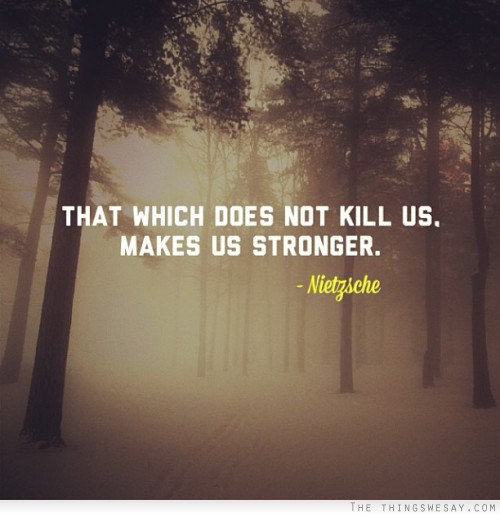
I never thought that I would be using a quote from the atheist philosopher Friedrich Nietzsche in one of my blog posts, but…
This quote came to my mind the other day and I began thinking about it and the man that wrote it. I spent most of February sick or recovering from the flu and other health issues. What little strength and energy I had before the illness has finally returned in the last few days. I’m definitely not physically stronger than I was before the illness. But I do feel spiritually stronger than I was before my battle with “that which did not kill me.”
As an atheist, Nietzsche only believed in the physical world so I can only assume that this quote was referring to trials making people (himself) physically and/or emotionally stronger. I wonder if he still believed those words while lying helpless and suffering from the effects of Syphilis for the last eleven years of his life.
As someone who has relied on caregivers for even longer than Nietzsche had to (ALS, not Syphilis), I empathize with the helpless, the suffering and their caregivers. But I feel great sympathy for those that do not place their hope and strength in Christ, regardless of the state of their health. I feel sympathy because, like Nietzsche, the “strength” and “hope” that they derive from physical/temporal pleasures do not provide genuine and lasting joy or peace. As King Solomon concluded, it’s “all vanity.”
I am convinced that the following is the only strength that can be gained from “that which does not kill us”:
“…we do not lose heart, but though our outer man is decaying, yet our inner man is being renewed (strengthened) day by day. For momentary, light affliction is producing for us an eternal weight of glory far beyond all comparison, while we look not at the things which are seen, but at the things which are not seen; for the things which are seen are temporal, but the things which are not seen are eternal.” (2 Corinthians 4:16-18)
There are so many great earthly pleasures and blessings, but not even the best of them deserve our hope. If Christ is our hope, the pleasures we enjoy on earth will be so much more enjoyable because we’ll have our priorities in order and we won’t have to rely on the physical/temporal things for happiness.

“For in hope we have been saved, but hope that is seen is not hope; for who hopes for what he already sees? But if we hope for what we do not see, with perseverance we wait eagerly for it.” (Romans 8:24-25)
 Unshakable Hope